(Slightly revised on Dec. 26, 2025)
The sources recounting Jesus’ public life place his activities in Galilee and Judea during the first third of the first century C.E. (the “Common Era,” which is the equivalent of the more familiar “A.D.”) In discussing Jesus and his teachings it is good to know some basics about life in these places at that time.
Both were located on the land bordering the eastern Mediterranean Sea. On the map below they would be in the area south of the city of Antioch on the right side of the map and include the city of Jerusalem below that.
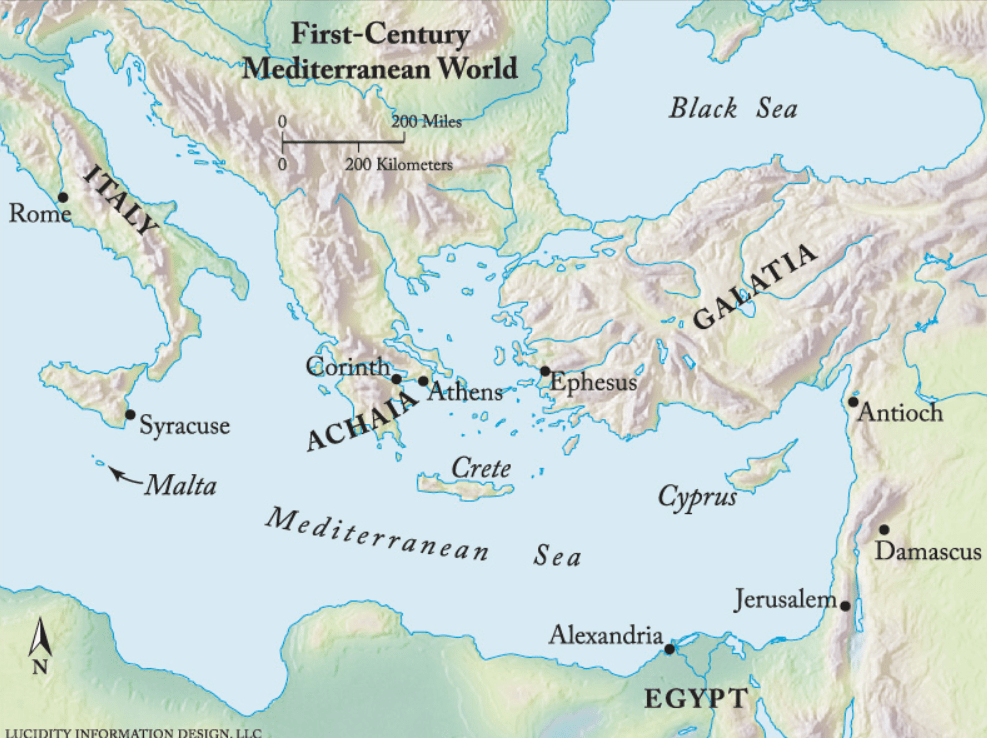
The area was populated by Jews, a people tied together by ethnicity and culture. In their sacred writings they traced their ancestry back to twelve tribes which migrated to Egypt during a famine and were enslaved there, later to be freed by the intervention of their God. The tribes moved north into this area, displacing previous residents, and eventually united into a single kingdom, Israel, with its capital at Jerusalem.
In subsequent centuries large parts of the territory of ancient Israel fell under the control of different empires, including the Assyrian, Babylonian and Persian empires and the Hellenistic empire created by Alexander the Great. In 141 B.C.E. (Before the Common Era) a successful Jewish revolt led by members of the Maccabee family established Judea as an independent state in the area surrounding Jerusalem. This ended in 63 B.C.E. when the Romans invaded the region, installing King Herod “the Great” as a client king ruling over the larger territory along the coast of the Eastern Mediterranean. On Herod’s death in 4 B.C.E. the Romans divided up his kingdom and placed different parts under different rulers.
Jesus is portrayed in the Christian sources as conducting most of his public life in Galilee, which was under the control of King Herod’s son, Herod Antipas. In the closeup of the area in the map below, Galilee is shown in a dark peach color in the upper left quarter of the map. The sources say that at the end of his life Jesus was in Judea to participate in the Jewish celebration of the Passover at the Temple in Jerusalem, where animal sacrifices were made to the God of the Jews. At the time Judea was under the direct control of the Romans via the governor Pontius Pilate, although he left much of its administration to the Sanhedrin, a body primarily composed of elders of the Jewish priestly families overseeing the Temple. Judea is colored tan in the lower left quarter of the map.
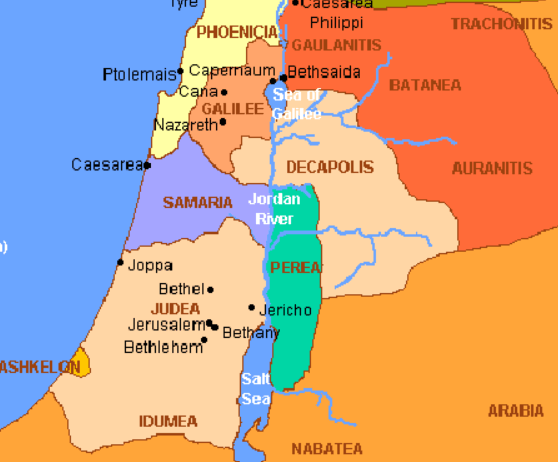
As a longtime capital city and the location of the Temple, Jerusalem and thus Judea were at the center of Jewish political and religious life. Galilee, however, was a rural area, with a variety of crops and a thriving fishing business on the Sea of Galilee. Its Jewish residents spoke Aramaic with a distinctive accent somewhat differentiating them from their fellow Jews in the south. Two cities, Sepphoris and the Galilean capital of Tiberias, were located there. During the first century C.E. construction in these cities and a landowning class driving peasants off the land were disrupting traditional ways of life and widening social divisions. You can see this Galilean background in many of the sayings of Jesus handed down by his followers, with their references to farming, fishing, rich people and tax collectors.
The social unrest and chaffing at foreign rule produced a tradition of Jewish “apocalyptic” writings and preachers. This tradition was one in which secrets about God’s plans for empires and nations were revealed to chosen prophets in symbolic visions. The prophets were to convey their message to the people so that those “in the know” could interpret their meaning. At that time those secrets often included the imminent end of all contemporary political arrangements and the restoration of the Israelite kingdom by a God-approved leader, the Messiah, meaning “the anointed.” The Greek equivalent was “the Christos,” translated into modern English as “Christ.”
It was into this world that Jesus was said to have been born, lived his life, gathered his disciples, and been executed by the Roman authorities.
 Jesus Reconstructed