(Updated May 24, 2026)
As I discussed previously, Paul handed down an early Christian tradition which in part said:
Christ died…he was buried and…he was raised on the third day in accordance with the scriptures. (I Corinthians 15:3-4)
Nowhere in the letters we have from Paul does he tell us how or where Jesus was buried or how it was known that he rose on the third day. For that information we have only the Christian gospels. On this page I will examine the gospels as sources for history before analyzing their stories about the burial of Jesus’ body and subsequent events. The hypothesis I will support is:
H5. The four gospels have serious limitations as sources for historical events and inferences from them should be made with caution.
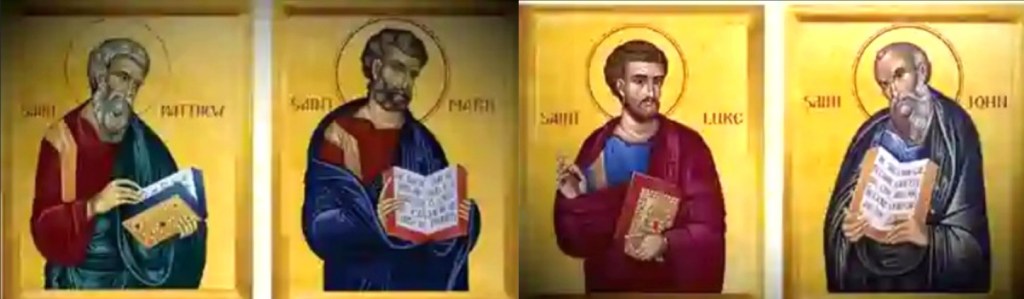
“Gospel” (in Greek, euangelion) means “good news,” a message announcing some event to be publicly celebrated. Before its use by Christians it would refer to an important political achievement, such as a military victory or the establishment of peace by a political leader. Christians adopted the word in heralding Jesus’ victory over death and the immanent arrival of the “kingdom of God.” Paul, for example, often used the word as shorthand for the death and resurrection of Jesus. Conveying their understanding of this message was central to the aims of the writers of the four books under discussion here. In short, the gospel was their topic and not originally a term for the books they wrote. The books were not called “gospels” until later.
Since the 1992 publication of Richard Burridge’s first edition of What Are the Gospels?, his thesis that the Christian gospels actually fit the genre of the ancient Greco-Roman bios has received wide support. A bios (“life”) is a medium-length (in terms of the literature of the time) prose narrative focusing on the deeds and words of a particular person, usually someone famous. Overall they have a chronological structure, usually from either birth or entry into public life to death, with a variety of anecdotes, stories, sayings and speeches from various sources sandwiched between and often organized in a more topical manner. Authors felt free “to select and edit sources to produce the desired picture of the subject” (Burridge, 2004: 198-199) and had a mixture of aims such as informing, instructing, preserving memories, defending the subject and attacking opponents, as well as holding the attention of the target audience for the book.
The gospels were written in koiné Greek, not the high literary style of Attic Greek, and we can assume they were aimed at a popular audience, probably including illiterate listeners as written works were usually read aloud to groups of people. The gospel now conventionally attributed to “Mark” (the authors are not named in the books) can be read aloud in under two hours. Popular bioi were “quite common,” although less likely to be preserved than bioi aimed at an audience higher on the social scale. (Burridge, 2004: 235)
Matthew Ferguson, in a 2015 conference paper and a 2016 blog post based on his paper, expanded upon the distinction between bioi aimed at a more educated readership and those aimed at a popular audience. The former are “historiographical” bioi which identify their author and use sources critically. The latter “novelistic” bioi feature an anonymous author, an omniscient narrator, a description of direct speech, and the creative adaptation of both written sources and oral traditions, all of which are features of the gospels. Did authors of bioi ever just make things up? Michael Licona writes that it is “clear that ancient biographers varied in the liberties they took pertaining to their use of embellishment and invention” and “the commitment to accuracy and the liberties taken could vary greatly” (Licona, 2010: 204). I infer that the gospels, as novelistic bioi, lean toward “embellishment and invention.”
The four gospels now included in the Christian canon were not the only gospels circulating in ancient times, but they are likely the earliest ones. When they were written has long been in dispute. The fragments of actual manuscripts that have survived date from about the mid-second century or later, so scholars mostly rely on internal evidence for the dating of the gospels. The leading position is that they were written after the beginning of the Jewish revolt in 66 C.E., and at least three of them after the Romans destroyed the Temple in 70 C.E., as they show signs that the authors were aware of that catastrophic event in Jewish history. On the other end, they were probably written before 115 C.E. as the authors show no sign of knowing about the Jewish revolts of 115-117 that took place in cities across the Roman empire, a topic that would have been of interest to them. (Akenson, 2000: 98-100)
That Mark’s gospel was the earliest is indicated by its short length and his less detailed references to the destruction of the Temple. On the former point, the Jewish scriptures and the para-biblical texts of the time generally expand upon previous sources; they do not delete large chucks of relevant material. The gospels of Matthew and Luke demonstrably include a large amount of material in Mark (about 90% of Mark in Matthew and 50% in Luke) along with a significant amount of additional material not found in Mark. (Akenson, 2000: 106-108)
If the dating of the letters of Paul in the 50s is correct, that means the gospels were written more than a decade later and in a radically changed social environment. The war of 66-73/73 resulted in the razing of Jerusalem and destruction of the Temple, the center point of Jewish worship. Many people died or were sold into slavery, refugees fled Galilee and Judea, lands were confiscated, and the Jewish governing structure ceased to exist. The surviving early Christians from these areas were, like the rest of the Jewish community, dispersed from their homes and distressed at the radical change in their political and religious situation. The gospels read as an attempt to explain God’s purpose in the light of this situation, centering on the story of Jesus as a way to convey this. As witnesses to his life would have been dead or hard to track down, the authors of the gospels relied primarily on oral reports of stories and sayings, whatever useful written sources were available, and creative writing.
There is wide agreement among those who have studied the texts that the author of the gospel of Matthew copied from Mark, and the author of the gospel of Luke copied from either Mark or Matthew or both of them. These three gospels are collectively called “the synoptics,” from the Greek words “seeing together.” The gospel of John has enough discrepancies with the synoptic gospels that it has often been treated as a separate source. More recently experts on John’s gospel have been challenging that assumption, arguing that John knew one or more of the synoptics. There are also signs that John’s gospel in its original form had been subject to further editing before it reached the version we now have. For my purposes here, I assume John based his narrative of the death, burial and resurrection of Jesus primarily on the synoptics, although he may also have had access to other sources which caused him to make significant changes from the previous three versions. I will discuss the relation of John to the synoptics more fully on a future page.
What we therefore should expect from the gospels is creative story-telling meant to make a point, especially to explain and spread their interpretations of the significant of Jesus’ life, death and resurrection. The authors may have made use of whatever factual information was available to them, but they would have felt free to shape the story and perhaps invent incidents in line with their literary objectives. This freedom is apparent in how at least two of the gospel authors likely copied from another one while making obvious changes to it, as we shall see in my discussion of their handling of the events after Jesus’ death.
Next page: 3e. The burial of Jesus’ body
Sources cited
Akenson, Donald Harman (2000). Saint Saul: A Skeleton Key to the Historical Jesus. Oxford University Press.
Burridge, Richard A. (2004). What Are the Gospels? A Comparison with Graeco-Roman Biography, 2nd edition. William B. Eerdmans Publishing Company.
Ferguson, Matthew. (2015). “The Certamen of Homer and Hesiod and the Gospels of the New Testament: A Comparison of Biographical Genre.” Presented at the Pacific Coast Society of Biblical Literature, March 2016.
Ferguson, Matthew. (2016). “Greek Popular Biography: Romance, Contest, Gospel.” ἱστορία φιλοσοφία σκέψις website.
Licona, Michael R. (2010). The Resurrection of Jesus: A New Historiographic Approach. IVP Academic.

