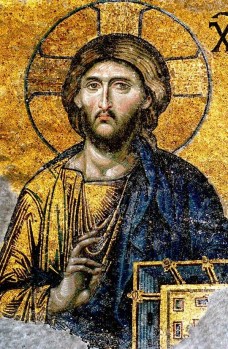
Here is the first of two parts from my near final draft about Paul’s list of the appearances of the risen Christ in 1 Corinthians 15. There is additional material compared to the version now up on this website, but I reach the same conclusions. Comments and notice of typos are very much welcome.
3b. Paul’s list of Jesus’ appearances
The earliest Christian documents we have copies of are probably the letters of Paul to various Christian communities around the Mediterranean. Dating such documents is tricky, but the academic consensus is that he wrote most of them in the decade of the 50s C.E. That would be about twenty years after the presumed date of the death of Jesus and about fifteen years or more before the earliest gospel we know of, the one attributed to Mark. In other words, about mid-way in the approximately three or four decades between the reports of the resurrection and the first written narrative of Jesus’ life. Much of what we know about Christianity during those decades comes from the letters of Paul.
The Christian Bible contains thirteen letters attributed to Paul, but Biblical scholars regard only seven of them as genuinely written by Paul. His letters do not show much interest in Jesus’ life, focusing instead on the meaning of his death and resurrection and offering instructions to the communities he wrote to. Paul expected the end of the world as they knew it and the triumph of the “kingdom of God” to happen in the very near future, so his eyes were on the present and his mission of preaching to the non-Jewish Gentiles while waiting for the imminent return of Jesus as judge and ruler of all. (On another page of this website I will discuss Paul’s letters, the dates assigned to them by scholars, and why only some are regarded as genuine.)
Paul’s list of appearances of the risen Christ
In what is called his First Letter to the Corinthians Paul bequeaths us some information about the resurrection appearances of Jesus:
For I handed on to you as of first importance what I in turn had received: that Christ died for our sins in accordance with the scriptures and that he was buried and that he was raised on the third day in accordance with the scriptures and that he appeared to Cephas, then to the twelve. Then he appeared to more than five hundred brothers and sisters at one time, most of whom are still alive, though some have died. Then he appeared to James, then to all the apostles. Last of all, as to one untimely born, he appeared also to me. (1 Cor. 15: 3-8, all English translations from the Greek here are from the New Revised Standard Version Updated Edition of the Christian Bible)
Paul’s language of handing on and receiving information of “first importance” implies carefully passing down a tradition with a set verbal formulation. That formulation starts with the kernel of Paul’s missionary message, that Christ died for our sins as predicted in the Jewish scriptures, that he was buried, and that God raised him from the dead, again as predicted in the scriptures. There are several shorter statements about Jesus being raised from the dead scattered throughout Paul’s letters, also likely of earlier origin. (Lüdemann, 2004: 32-33; Allison, 2005: 229-231) In this particular passage Paul goes on to include a list of appearances of the risen Jesus: to Cephas (which roughly means “man of stone” in Aramaic, as does “Peter” in Greek), “the twelve” (apostles), five hundred Christians at one time, a “James” with no further identification, “all” the apostles, and then finally Paul himself. Dale Allison (2005: 234) notes that the formula uses words and expressions that Paul does not use elsewhere in his letters, such as “sins” in the plural, “according to the scriptures,” “has been raised” in the perfect tense, “appeared to” (or “was seen by”), and “the twelve.” This is another sign that he is passing down an earlier tradition.
But is the traditional formula exactly as Paul has conveyed it? The comment regarding the five hundred, “most of whom are still alive, though some have died,” would be Paul’s, as a tradition composed to be carefully handed down would not indicate whether witnesses were still alive at a particular time. And consider that Paul includes himself at the end of the list. Elsewhere he confirms that he is a first-hand witness to an appearance of Jesus (1 Cor 9:1-2), but would an earlier tradition been have passed down to him saying that Paul himself was “last of all, as to one untimely born”? (The phrase “one untimely born” compares his experience to the abortion or miscarriage of a pregnancy, apparently meaning something that occurs before one is ready for it. See Wright, 2003: 327-329) Why would the originators of the tradition think he was last and why would they bother to describe his experience as untimely? I don’t think it’s likely they did; it is more likely Paul added himself to the end of the traditional list to defend his claim to be an apostle, despite not having been one of those originally recognized as apostles.
This raises the question of where the traditional list ends and Paul’s addition(s) begin: just before Paul is listed or at some point before that? It is important to note that Greek was written without punctuation at that time, so translators to modern English have to guess where sentences begin and end. The problem of where exactly the original tradition ended was in discussion as early as 1978 (Allison, 2005: 234), with most commentators holding that it ended either with “Cephas” or with “Cephas, then the twelve.” (Barclay, 1996: 16) Bart Ehrman (2014: 139-142) is among those who argue that it ends after the mention of Cephas. That would leave a formulation with a parallel structure easy to remember and convey to others:
Christ died/for our sins/in accordance with the scriptures/and he was buried.
Christ was raised/on the third day/in accordance with the scriptures/and he appeared to Cephas.
The first section in each line is a parallel statement about Christ (he died/he was raised). The second section ties the statement to a prophecy derived from the Jewish scriptures (for our sins/on the third day). The third section is exactly the same in each line (in accordance with the scriptures), following up the previous section. And the final section is a brief conclusion (he was buried/he appeared to Cephas). It is a tightly constructed set of parallel statements, which would be asymmetrical if much more was added after the mention of Cephas. That would suggest that the rest of the list was added by Paul from some source(s) other than the tradition as it had been handed down to him.
If this argument is correct, the tradition would be the earliest source concerning who was the first to claim to have seen Jesus after his death: Cephas/Peter. Peter as a key witness to the risen Christ fits other evidence that Peter was a central figure in the early Christian community, such as Paul’s reference to him as a “pillar” of the Christian community in Jerusalem in another letter (Galatians 2:9), his prominent role in the gospels (four Christian scriptures narrating the life, death and resurrection of Jesus) and the Acts of the Apostles (a history of the early Christian community), and letters to early Christian communities that were purported to have been written by Peter. In the gospel of Luke there is also an indication that Peter was the first to take heart after the death of Jesus, as predicted by Jesus (Simon was Peter’s original name before he was renamed Cephas/Peter):
“Simon, Simon, listen! Satan has demanded to sift all of you like wheat, but I have prayed for you that your own faith may not fail, and you, when once you have turned back, strengthen your brothers.” (Lk 22: 31-32)
I am not arguing that all of these stories about Peter were true, but rather that he was important enough to have such stories told about him. Based on the evidence, I think Peter was the first to experience what he took to be a resurrected Jesus, and that his claim was carefully preserved and handed down in the larger Christian community. I don’t think we will ever know exactly what Peter saw, but apparently it was convincing enough to bolster his confidence and become a turning point for him, for the other early disciples, and for the rest of Western history.
The subsequent mention of an appearance to “the twelve” also may have been a part of the original tradition. Its inclusion would not disrupt the balance of the parallel structure of the original list very significantly. Gert Lüdemann (2004: 40-43) takes the position that the “twelve” was part of the original list. He notes that the conjunction between “Cephas, then (eita) to the twelve” differs from the conjunction that precedes the sentence about the five hundred and the one about Jame and all the apostles. That word in Greek is epeita, which Lüdemann translates as “thereafter.” As I recount on another page, three of the gospels and the Acts of the Apostles all describe scenes of Peter with other apostles seeing the risen Jesus. These likely trace back to knowledge of the tradition Paul recounts.
The other appearances on the list, aside from Paul’s own experience, would then be appearances that Paul learned of after receiving the original tradition. You would think five hundred people seeing the resurrected Jesus at the same time would be dramatic enough that reports of it would reach those undertaking to write about Jesus, but there is no mention of it in any other source. A suggested reference to the appearance is in the Acts of the Apostles. (Lüdemann, 2004: 73-81; Allison, 2005: n. 140 on 235) The Acts is a narrative of the early Christian community which is universally attributed to the author of the gospel of Luke. In Acts Chapter 2:1-42 the disciples are gathered together on the feast of Pentecost, celebrated fifty days after the Jewish holiday of Passover, which the gospels depict as the time of Jesus’ death. They are “filled with the Holy Spirit” and begin speaking in other languages, which Jewish people from around the eastern Mediterranean who are present in Jerusalem hear and recognize. After Peter preaches to them, “about three thousand” are baptized and join the Christian community. But other than a miracle and the huge size of the crowd in Paul’s list and in the story, there is little resemblance between the two. In one the miracle is an appearance of the risen Jesus, in the other it is speaking in various languages under the influence of the Holy Spirit. (Wright, 2003: 324-325) And three thousand is a lot more people than five hundred.
Nor is there any other mention of an appearance to James in the early sources, unless this was James the apostle and he saw Jesus as one of several unnamed apostles present at one of the appearances to disciples depicted in the gospels. The lack of identification in the formula suggest he was a known figure in the Christian community. Most commentators take James to be “James, the Lord’s brother” that Paul refers to in Galations 1:18-19 and is presumably also the James who Paul calls a “pillar of the church” along with Cephas and John in Galations 2:9. James’ status suggests he had claimed to see the risen Jesus, but this is not made explicit in any early source. Who “all the apostles” were and what they claimed is also unknown.
In my judgment, Peter is the only person on Paul’s list whose experience, whatever it was, is convincingly attested as widely known and carefully handed down by the early Christians. His experience was the foundation for the belief in the resurrection of Jesus and the catalyst for other reports of appearances. Once the idea of the resurrection took hold, additional reports would have a ready audience among those who believed, no matter the substance of the reports or their lack of it. Paul may not have heard about these other reports until years later, nearer the time he added them to the end of the traditional list when he wrote to the Corinthians. The reports could have been second-hand or even more remote from the alleged events.
 Jesus Reconstructed