(Updated June 27, 2026)
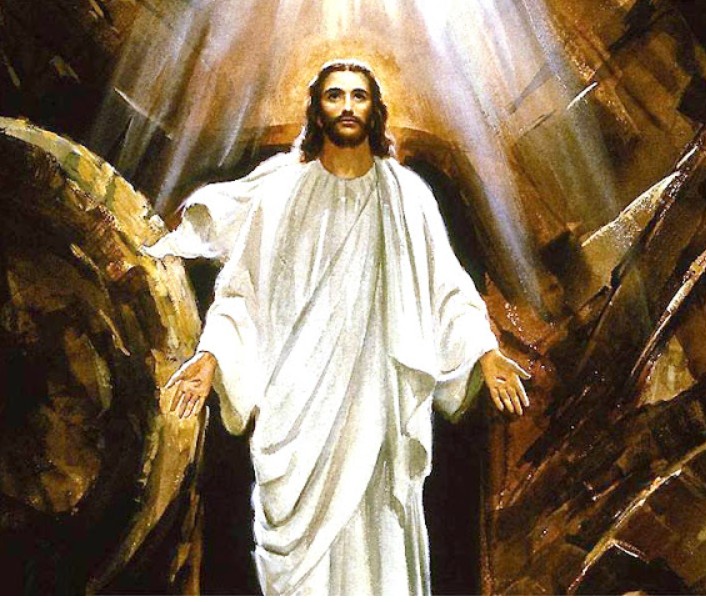
After recounting the burial of the body of Jesus, the author of the gospel of Mark continues the story:
When the Sabbath was over, Mary Magdalene and Mary the mother of James and Salome bought spices, so that they might go and anoint him. And very early on the first day of the week, when the sun had risen, they went to the tomb. They had been saying to one another, “Who will roll away the stone for us from the entrance to the tomb?” When they looked up, they saw that the stone, which was very large, had already been rolled back. As they entered the tomb, they saw a young man dressed in a white robe sitting on the right side, and they were alarmed. But he said to them, “Do not be alarmed; you are looking for Jesus of Nazareth, who was crucified. He has been raised; he is not here. Look, there is the place they laid him. But go, tell his disciples and Peter that he is going ahead of you to Galilee; there you will see him, just as he told you.” So they went out and fled from the tomb, for terror and amazement had seized them, and they said nothing to anyone, for they were afraid. (Mk 16:1-8)
My analysis of this story and its variations in the other three early gospels will support the following two hypotheses:
H7. Some women followers of Jesus returned to the site of his crucifixion but could not find where the body had been buried.
H8. The author of the gospel of Mark invented the empty tomb story to affirm several theological points about Jesus’ resurrection.
Many commentators have tried to explain the empty tomb on the assumption that its discovery was a real event, although usually regarding the “young man” as a fictional device to deliver the proper interpretation of the missing body. One common argument has been that the disciples stole Jesus’ body in the middle of the night and then claimed he had been resurrected, an argument known to the author of the gospel of Matthew, as we shall see. This strikes me as a difficult and risky endeavor without a realistic motivation. Other arguments include the swoon hypothesis, the lost body hypothesis, and the substitution hypothesis, all of which are to me even more improbable than a stolen body. Another is that Joseph of Arimathea moved the body to a different tomb before the women showed up. This would entail Joseph having a corpse moved either during the Sabbath, a violation of Jewish religious customs, or during the night after the Sabbath ended, which would be unnecessarily difficult when it could be done during the day. Yet another is that the two women who witnessed Jesus’ burial were confused and returned to the wrong tomb. To be confused like that, they would have been exceptionally unobservant during the whole process of watching the body being laid to rest and a big stone being rolled across the entrance to the tomb.
None of the above theories take the presence of the young man in the robe as having a historical basis. An argument which does was put forward by Charles Freeman. He suggests that the Jewish high priest Caiaphas had the body removed and posted junior priests, who as a custom wore white robes, to tell anyone coming to the tomb that Jesus rose and that they should go back to Galilee. Caiaphas’ motive would be to get Jesus’ disciples out of Jerusalem and Judea, that is, out of his hair. (Freeman, 2009: 32-34) I question whether Caiaphas would have gone to the trouble of removing Jesus’ body, when he could simply post a junior priest and have him warn any disciples who showed up to return to Galilee.
Furthermore, there are several problems with Mark’s story. The Romans prevented people from performing burial rites for crucified criminals, especially those executed for treason (Brown, 1994: 1207-9), so the women had no reason to expect they would be allowed to enter the tomb and anoint the body. They inexplicably returned to the tomb without a plan for removing the “very large” stone from the entrance. The young man in the tomb, presumably an angel (many Jewish scriptures describe angels appearing as human beings), conveniently explains why Jesus’ body is missing, an explanation which otherwise would not be the first explanation that comes to mind. And the women do not tell anyone what happened, which raises the question of how Mark knew about it decades later. (Mark’s gospel abruptly ends at this point, which I will discuss on my next page.)
The above considerations make the story suspect as history. The alternative is that it is largely or entirely fictional. Empty tomb stories were a common trope in Greco-Roman novels in the first century; the scholar Robyn Faith Walsh says that she has identified more than one-hundred twenty stories of missing bodies and/or empty tombs from that time period. (See this video at 19:50.) Here is a striking passage from the novel Callirhoe:
At the crack of dawn Chaereas turned up at the tomb, ostensibly to offer wreaths and libations, but in fact with the intention of doing away with himself; he could not bear being separated from Callirhoe and thought that death was the only thing that would cure his grief. When he reached the tomb, he found that the stones had been moved and the entrance was open. He was astonished at the sight and overcome by fearful perplexity at what had happened. Rumor—a swift messenger—told the Syracusans this amazing news. They all quickly crowded round the tomb, but no one dared go inside until Hermocrates gave an order to do so. The man who was sent in reported the whole situation accurately. It seemed incredible that even the corpse was not lying there. Then Chaereas himself determined to go in, in his desire to see Callirhoe again even dead; but though he hunted through the tomb, he could find nothing. Many people could not believe it and went in after him. They were all seized by helplessness. One of those standing there said, “The funeral offerings have been carried off — it is tomb robbers who have done that; but what about the corpse — where is it?” Many different suggestions circulated in the crowd. Chaereas looked towards the heavens, stretched up his arms, and cried: “Which of the gods is it, then, who has become my rival in love and carried off Callirhoe and is now keeping her with him — against her will, constrained by a more powerful destiny? That is why she died suddenly — so that she would not realize what was happening. That is how Dionysus took Ariadne from Theseus, how Zeus took Semele. It looks as if I had a goddess for a wife without knowing it, someone above my station. (As translated by B.P. Reardon)
Note the mourner who shows up at dawn to pay proper respects, the stones moved from the entrance, the astonishment and perplexity of the witnesses, the fruitless search of the tomb, and the mourner’s conclusion that the deceased had become a goddess, taken up to live with a god. In this story the reason for the body’s disappearance is that the woman who supposedly died had recovered in the tomb and tomb robbers carried her off into slavery. But many of the elements of the scene are the same as those in Mark.
B.P. Reardon, a noted scholar of ancient Greco-Roman novels, placed the author of Callirhoe in about the middle of the first century, roughly the same time Mark is thought to have written his gospel. I haven’t seen any detailed argument that one drew directly from the other, although there is speculation about the possibility. N.T. Wright suggests the authors of such fictional stories may have heard the Christian story of the empty tomb and appropriated the concept. He dismisses the opposite possibility, writing that for Mark to invent his story based on “a plot-twist in a romantic novel is patently absurd.” (Wright, 2003: 72) He does not explain why he thinks it absurd. The general view of experts seems to be that both are examples of a type of story told in different ways about different figures that had common elements various storytellers drew from.
Bible scholars have also pointed out that the young man in the white robe at the tomb has undertones of the Christian ritual of baptism. Earlier in his gospel Mark suddenly introduces a young man who loses his “linen cloth” garment and flees naked at Jesus’ arrest. (Mk 14:51-52) The two young men who bracket Jesus’ passion story, the naked one at the arrest and the messenger at the empty tomb, mirror the process of baptism into the Christian community. It begins with shedding one’s garment as a symbol of death. Mark specifies that Jesus’ body was wrapped by Joseph in a “linen cloth,” and the young man at the arrest loses the linen garment he was wearing. The baptismal initiate is then immersed in water, reenacting Jesus’ burial and descent into the realm of death. Upon arising from the water the initiate dons of a white robe, like the white robe of the man at the tomb, symbolizing resurrection in a glorified body. (Lüdemann 2004: 85-86)
In a video interview Dr. Dennis MacDonald argued that the man who lost his garment is itself based a Greco-Roman literary trope of a man who dies in a story first recounted by the ancient Greek poet Homer. In Homer’s Odyssey a young man “flees” his body after falling off a roof and goes down to Hades, but he cannot enter Hades until Odysseus gives him a proper burial. An allusion to this story, familiar to an audience such as Mark’s who were conversant with Greek culture, would bring to mind the idea of a premature death and descent into the world of the dead.
Jane Schaberg points to parallels with apocalyptic visions, such as the one in the Jewish book of Daniel (Daniel Ch. 7). A faithful Jew is troubled by the suffering of their people (the women in Mark, Daniel in the book of Daniel). They see something strange which causes amazement (the empty tomb, a vision of four beasts). An angelic figure explains the meaning of the vision. The seer is terrified but keeps silent about the vision, although it is later set down in the text at hand. (Schaberg, 2002: 286-288) Note also that later in the book of Daniel (Daniel 12) the seer hears from an angelic figure “clothed in linen” about the future resurrection and judgment and is instructed to keep what he hears secret.
In my judgment, Mark’s heavy overlay of literary tropes and religious symbolism is an indication that his story of the empty tomb is a fictional creation meant to convey theological meanings. This corresponds with my hypothesis discussed on the previous page that the women who witnessed the crucifixion never saw where Jesus’ body was buried. Mark would have wanted to provide a dramatic and memorable scene to follow the climax of Jesus’ crucifixion, as well as having at least three theological aims in creating it:
First, the aforementioned scholar Robyn Faith Walsh has said that a reader of that time and place would have interpreted Mark’s empty tomb story as indicating Jesus “was a god,” his divine status following from the implication that he had been raised bodily to heaven. This could mean either that Jesus had always been a god and temporarily took human form or that he became divinized at the time he was raised from the dead; either option could have been Mark’s intention.
Second, the empty tomb demonstrates that the resurrection involved a transformation of Jesus’ corpse—that is, it was not simply that his disembodied spirit had survived death and appeared to people like Peter and Paul. This point addresses the controversy over the nature of resurrected bodies that Paul writes to the Corinthians about, a controversy that clearly persisted beyond Paul’s time. The empty tomb affirms the belief that the general resurrection at the end times involved bodies rising from the earth where their physical remains had been. As the first of those to be raised, Jesus had to correspond to the expected pattern. The possible apocalyptic element also points forward to the end times with the resurrection of the dead taking place before the final judgment. This is especially true if Mark means to invoke the book of Daniel, an idea that Schaberg presents further evidence for, as we shall see below.
And third, Mark’s sequence of events validates the early tradition Paul cites that Christ was raised “on the third day in accordance with the scriptures.” Day one is the day Jesus dies and his body is buried, the day ending as evening falls. On day two the women observe the Sabbath rest from that evening to the following one. Day three begins as the Sabbath ends, with the women sensibly waiting until morning to return to the tomb. The young man in the tomb tells them Jesus has risen and will appear to Peter and the disciples in Galilee, presumably because that was the actual location of the first appearances. Galilee is a multi-day journey from Jerusalem which the disciples would not have undertaken until after the Sabbath. Therefore the first appearances of the risen Jesus in Galilee had to have taken place at a minimum several days later, not on the “third day” after his death. Mark’s story of the discovery of the empty tomb provides confirmation that the resurrection happened on the third day, as in the tradition recounted by Paul, and not later when the first appearances were experienced.
But if the empty tomb story story is fictional, where did the tradition of Jesus being raised on the third day come from? Most commentators focus on trying to identify where in the Jewish scriptures the disciples could have seen a prophecy predicting the Messiah rising from death on the third day. The assumption seems to be that the disciples fitted their tradition to the scripture, not that something happened on the third day and they searched the scriptures to show it was ordained by God. To the best of my knowledge, the leading contender for the reference is a passage from the book of the prophet Hosea:
“Come, let us return to the Lord, for it is he who has torn, and he will heal us; he has struck down, and he will bind us up. After two days he will revive us; on the third day he will raise us up, that we may live before him. Let us know, let us press on to know the Lord; his appearing is as sure as the dawn; he will come to us like the showers, like the spring rains that water the earth.” (Hosea 6:1-3)
The passage is not an obvious reference to the Messiah, as the use of the plural pronoun “us” refers to the Jewish people. Although the Messiah was sometimes understood as acting as a representative of the whole community, the passage does not necessitate this interpretation, and nowhere in the Christian scriptures is the passage from Hosea clearly cited.
Schaberg proposed that the scriptural reference to the “third day” was in Ch. 7 of the book of Daniel discussed above. In Daniel’s vision the four beasts represent successive kingdoms which God destroys. This is followed by a vision of God on his throne overseeing a court of judgment. One like a “human being” (literally, a “Son of Man,” a phrase which in Mark’s gospel Jesus often uses to refer to himself) is then given everlasting dominion over all people. The angel explains that the fourth beast will have power “for a time, two times, and half a time” before the divine court takes away his dominion and delivers it to “the holy ones of the Most High.” (Daniel 7:25-27) The “time, two times, and half a time” phrase means “soon,” but could have been taken to be a prediction of Jesus being under the power of death for three days before God destroys death’s hold over him. (Schaberg, 2002: 271- 276, 283) The phrase is repeated as “a time, times and half a time” in the subsequent vision of Daniel about the resurrection at the end times. (Daniel 12:2-7)
But I don’t think the disciples who originated the tradition based the “third day” part of it simply on a reference in the Jewish scriptures. They easily could have omitted any supposed scriptural reference to the third day if they didn’t believe something actually happened on the third day after Jesus’ death, by saying “he was raised in accordance with the scriptures.” The process of formulating the tradition transpired in the opposite way: something happened on the third day after Jesus’ death, and the disciples then found scriptures to show this was part of God’s plan.
It is plausible that the women returned to the site of the crucifixion on the day after the Sabbath to try to locate where Jesus’ body was buried. This would have been to perform the ritual duty of weeping and singing lamentations, not to anoint the body (Corley, 2002: 128-129), which would require their unlikely access to the corpse. To lament they would only need proximity to where the corpse was buried, or, failing that, to the site of his death. They probably could not locate the burial place and were afraid to ask the authorities. According to Corley, citing an earlier source, empty tomb stories “most commonly evolve when the location of the remains of a venerated figure is unknown.” (Corley, 2002: 138-139) The tradition therefore could have been based on the women reporting to other disciples that they returned to the crucifixion site the day after the Sabbath and tried to locate the body but could not find it. After the appearances of Jesus to Peter and others in Galilee, the failure to find the body would have been seen in a new light. The women could not find the body, and Jesus later appeared to some of his disciples, ergo Jesus must have been raised from the dead.
Given my previous discussion of the genre of the gospels as novelistic bioi, I think this explanation of the empty tomb best fits the evidence. I will go a step further and speculate that the women composed and performed a lamentation that included an expectation that Jesus’ faithfulness to God despite facing torture and death would result in his resurrection. This theme was a common one at the time, as can be seen in a passage from Ch. 2 of the Jewish text 2 Maccabees in which the members of a Jewish family who are about to be martyred for their faithfulness to God proclaim their belief that they will be raised to life again as a reward. Given the prominence of Mary Magdalene in Mark’s story, it is possible that her name was associated not only with witnessing the crucifixion of Jesus and the removal of his body from the cross, but with composing and/or singing this kind of lamentation for him. Mark’s avoidance of showing the women lamenting could be a reflection of the male disapproval of such rituals common throughout Greek, Roman, and Jewish societies of the time. (Corley, 2002: 106) Another possible indication of this disapproval may be found in the gospel according to Luke, where he portrays Jesus telling the women who are wailing and beating their breasts as he is led to his crucifixion, “Daughters of Jerusalem, do not weep for me, but weep for yourselves and for your children.” (Lk 23:27-31)
To complete my analysis of Mark’s story, I propose that he describes the women as saying nothing about the empty tomb because no one had heard of it before he wrote his gospel. Mark is relying on a collective memory that the women returned to the site where criminals were crucified and buried but could not find Jesus’ body. He suggests that they did not tell the full story of their discovery of the empty tomb and the “young man” who greeted them there because they were in shock about what they experienced. In reality it was Mark who added the details of Joseph of Arimathea burying the body, the stone blocking the entrance to the tomb, the young man pointing out the missing body, and the man/angel’s message that Jesus had risen and would later appear to his disciples in Galilee. Mark felt justified in doing this in order to make theological points that he believed were important and true: Jesus was raised to heaven as a divine figure, his corpse was transformed as the first of those to be resurrected, and this happened, as tradition held, “on the third day in accordance with the scriptures,” not days later when the disciples arrived back in Galilee.
The author of the gospel of Matthew follows Mark’s basic story line, but with at least two significant changes. One is his awkward insertion after Jesus’ burial of a scene with the chief priests and Pharisees going to Pilate on “the next day, that is, after the day of Preparation,” to ask for soldiers to seal the stone at the entrance of the tomb and post a guard so that the disciples would not be able to steal Jesus’ body and claim he was resurrected. (Mt 27:62-66) The historicity of this is doubtful for two reasons. First, it is hard to see how Matthew could have known about the meeting between the leaders and the soldiers. Second, the leaders’ actions are implausible. Jesus is executed on the day of the Passover, which in Matthew’s telling also would have been the “day of preparation,” presumably preparation for the Sabbath. The “next day” then would be the Sabbath, and priests would not have engaged in any activity on the Sabbath. (Wright, 2003: 637) This part of Matthew’s story was clearly created in an attempt to respond to an argument that the tomb was empty because the disciples stole the body, suggesting that Mark’s story of the empty tomb had become widely known by the time Matthew was writing his gospel.
Matthew then moves on to the morning after the end of the Sabbath. He drops Salome as a companion of the two Marys who return to the tomb, presumably to simplify Mark’s varying number of women in different parts of his short narrative. He also drops any mention of them wanting to anoint the corpse or needing to remove the stone, a couple details that I noted as implausible in Mark; Matthew writes that they “went to see the tomb” without further explanation. The dramatic and miraculous nature of what they discover is heightened by the addition of an earthquake and an angel coming down from heaven with an appearance “like lightening” to roll away the stone in front of them. The fear-struck guards ironically become “like dead men” themselves. The angel announces the resurrection and conveys the message that disciples will see Jesus in Galilee. Unlike in Mark, the women leave the tomb not only in fear but with “great joy” and run to tell the disciples what happened. (Mt 28:1-8) This is another indication that Mark’s empty tomb story was well known by this time, as Matthew sees no need to portray the women keeping quiet about it.
In a second significant change, Matthew briefly depicts Jesus greeting the women on their way to give the disciples the angel’s message. The women take hold of Jesus’ feet and worship him, reinforcing the theological points that Mark had hinted at: Jesus was now a divine figure, his resurrected body originated with his corpse, and the resurrection had taken place on the “third day” as Paul’s early tradition stated. But the story primarily strikes me as a second response to the accusation that the disciples stole Jesus body: two women were eyewitnesses to the risen Jesus near the site of his tomb. Apparently, exercising creative license to make the aforementioned points was more important to Matthew than adhering to the older tradition that Peter had been the first witness to an appearance. Jesus then redundantly tells the women that his “brothers” will see him in Galilee, which to me indicates the scene has no narrative purpose other than buttressing Mark’s theological claims and responding to critics of the resurrection proclamation. (Mt 28:9-10)
After the women leave the tomb the soldiers report to the chief priests “everything that had happened.” The leaders oddly show no surprise or confusion that an angel had descended from heaven to proclaim that Jesus had been raised from the dead. Instead they set to work on a cover-up story and bribe the soldiers to say they fell asleep and the disciples then stole the body, reassuring them that if the governor hears about it, they will “satisfy him and keep you out of trouble.” How the priests could have satisfied Pilate if he heard that the soldiers fell asleep and the body went missing—the latter of which he was sure to hear—goes unspoken. Matthew adds that “this story is still told among the Judeans to this day,” confirming that the argument about the disciples stealing the body was prevalent in his time. (Mt 28:11-15)
As expected of the author of a novelistic bios, Matthew exhibits creative freedom in retelling Mark’s story and adds his own new material for clearly discernible literary and theological reasons.
The gospel according to Luke has a briefer retelling of Mark’s story. The women return to the tomb with their anointing spices and see that the stone has been moved and the body is missing. Suddenly two men in “dazzling clothes” appear and announce that Jesus has risen, as he had predicted to them “while he was still with you in Galilee.” The men use Jesus’ term “the Son of Man” when speaking of him, here clearly a reference to the figure in the book of the prophet Daniel. (Lk 24:1-8)
Let’s pause to analyze Luke’s story so far. He maintains Mark’s claim that the women intended to anoint Jesus’ body, but like Matthew omits their belated puzzlement about how they will move the stone. He persists in refusing to name the women, a point I highlighted on the previous page. His reason for including an additional man appearing at the tomb is obscure, but his references to their sudden appearance and dazzling clothes seem to mirror Matthew’s description of the descending angel with an appearance “like lightening.” The women bow their faces to the ground similar to the way Matthew has them take hold of the feet of Jesus. The similarities to Matthew suggest that Luke may have had copies of both Mark and Matthew to work from. One significant departure from their stories is Luke’s omission of the instruction for the disciples to return to Galilee to see Jesus. As I will point out in the next page, Luke has his own reasons for placing the appearances of Jesus in Jerusalem rather than in Galilee.
Unlike Matthew Luke does not relate an appearance of the risen Jesus to the women, but like Matthew he has the women tell the male disciples what they experienced. It is only at this point that he identifies the women as “Mary Magdalene, Joanna, Mary the mother of James, and the other women with them.” The disciples do not believe them, but Luke inserts a line saying that Peter ran to the tomb and verified that Jesus’ body was missing. (Lk 24:9-10) This is an important addition, Luke’s way of asserting the primacy of Peter in the resurrection events over that of the women (and against Matthew’s account).
The gospel of John, as is typical of it, departs more radically from the other gospels but still shows influences from them. Mary Magdalene is the only woman who returns to the tomb. Her reasons are unspecified. She finds the stone moved and runs to tell Peter and another disciple, “They have taken the Lord out of the tomb, and we do not know where they have laid him.” The two male disciples run to the tomb and see the linen wrappings lying inside but no body. The author says the other disciple “believed” when he saw this, although he also says the two did not yet understand “the scripture” that Jesus must rise from the dead. The men then return to their homes. (Jn 20:1-10) This scene closely resembles Luke’s verse about Peter going to verify the empty tomb, except that another disciple is with Peter. The verse in Luke is not found in all of the early manuscripts of his gospel, and some scholars suggest it could have been added later by a copyist to harmonize it with the story in John. However, Gerd Lüdemann argues that it was likely original to Luke because the “language is distinctly Lukan.” He also argues that the Peter episode in John is a later insertion to the original manuscript of John based on the scene in Luke, as it interrupts the flow of John’s story and creates problems in the narrative. (Lüdemann, 2004: 110, 114-117) The importance of the scene for both gospel authors is that it makes Peter a witness the empty tomb, and in John’s version the first witness, even before Mary Magdalene.
John follows this with an interesting scene. Mary is still at the tomb, weeping, the only mention in the gospels of any of the women at the tomb weeping. I have already noted that weeping and lamentation were customary rituals for women when someone close to them dies. She looks into the tomb and, instead of being empty as it was when the two male disciples looked in, there are two angels in white sitting at the head and foot of where Jesus’ body had been. That there are two angels rather than one matches Luke’s account. The way John portrays them as sitting at the head and foot of the empty space seems to be an allusion to the ark of the covenant in the Jerusalem temple, where an empty “mercy seat” with the representation of two angels on either side of it signifies that God dwells there. (Wright, 2003: 668)
The angels, apparently unrecognized as such, ask why Mary is weeping, and she replies, “They have taken away my Lord, and I do not know where they have laid him.” Her statement, which is similar to her statement to Peter and the other disciple, syncs well with my hypothesis of women returning to the site of Jesus’ death and not being able to determine where the body was deposited. She turns around and sees Jesus and mistakes him for a gardener. He asks her why she is weeping and who she is looking for. She says, “Sir, if you have carried him away, tell me where you have laid him, and I will take him away.” Excepting for Mary’s offer to “take him away,” his question and her answer again sync with my hypothesis, with Mary questioning a presumed gardener for help locating Jesus’ body. The dual interactions, first with angels and then with the risen Christ, suggest John is revising Matthew’s account of a similar redundant interaction. Mary then recognizes Jesus and he tells her not to touch him (as she does in Matthew), “because I have not yet ascended to the Father.” Neither the angels nor Jesus ask her to convey a message that the disciples will see him in Galilee. Instead, his message is that he is ascending “to my Father and your Father, to my God and your God.” Mary then goes to the disciples and tells them she has “seen the Lord” and relays what he said. (Jn 20:11-18) As I will discuss on the next page, Luke and John stress the ascension of Jesus to heaven as an explanation of why his postmortem appearances had ceased by their time.
Lüdemann suggests that two stories which were originally separate have been awkwardly pieced together here. (Lüdemann, 2004: 117) The verses could be rearranged in this order:
Story 1:
v.1: Mary returns to the tomb and finds the stone moved.
v.11b-13: She looks in the tomb and sees two angels. They talk.
v.2-10: She runs to tell Peter, and he and the other disciple go examine the empty tomb. (The quotes from Mary in v13 and v2, which in this rearrangement are placed together, are nearly identical.)
Story 2
v.11a: Mary is weeping outside the tomb.
v.14b-18: She turns to see Jesus and does not recognize him. He asks why she is weeping and they talk. Mary goes to the disciples and tells them she has seen the Lord.
Story 1 is very much like Luke’s version of the empty tomb story, while Story 2 sounds like a revised version of Matthew’s scene of the women encountering Jesus.
This exercise (and other passages, see Lüdemann 2004: 119) shows how the author or final editor of the gospel of John draws elements from at least two of the three previous gospels; Luke (the two angels and Peter’s visit to the tomb) and Matthew (Mary’s encounter with Jesus). He combines and retells them with his own characteristic touches, such as the unnamed disciple who recurs at key moments in his gospel and more expansive scenes than in the other two gospels. I think he also may have had contact with the early tradition of the women who failed to find Jesus’ body, rather than deriving his story purely from the previous gospels, because of how Mary’s dialogues with the angels and with Jesus sound as they would in my hypothetical version of what actually happened. Perhaps a lamentation for Jesus was handed down from Mary Magdalene, with lines like “They have taken away my Lord, and I do not know where they have laid him.”
To sum up the results of my analysis, I propose that the story of the empty tomb had its origin in the women who returned to the site of the crucifixion, most prominently Mary Magdalene, but could not find Jesus’ body. Perhaps Mary composed a lamentation in which the missing body and an expectation of Jesus’ vindication by resurrection were themes. Reports of the subsequent appearances of Jesus to Peter and the disciples in Galilee were then combined with the memory of the women’s failure to find the body to generate the tradition Paul cites about Jesus being raised on the third day after his death. Mark drew on the tradition and embellished it to create a dramatic and theologically meaningful scene of the discovery of the empty tomb. Matthew appropriated and adapted Mark’s story, Luke drew on both Mark and Matthew for his version, and John drew upon Matthew and Luke and perhaps some knowledge of the early tradition from the women as well.
Sources cited
Brown, Raymond E., S.S. (1994) The Death of the Messiah: From Gethsemane to the Grave, A Commentary on the Passion Narratives in the Four Gospels, vol. 2. Doubleday.
Corley, Kathleen E. (2002). Women and the Historical Jesus: Feminist Myths of Christian Origins. Polebridge Press.
Freeman, Charles (2009). A New History of Early Christianity. Yale University Press.
Lüdemann, Gerd (2004). The Resurrection of Christ: A Historical Inquiry. Prometheus Books.
Schaberg, Jane (2002). The Resurrection of Mary Magdalene: Legends, Apocrypha, and the Christian Testament. Continuum
Wright, N.T. (2003). The Resurrection of the Son of God. Fortress Press.

