Was There a Passion Narrative Before Mark’s?

I recently took down my page about the crucifixion of Jesus because I decided I should not take the historicity of Jesus for granted in my writings on this website. In these times that is something that needs to be demonstrated rather than assumed, and I am looking into how persuasive a case can be made.

But if you had read that page, you may remember that I thought it likely that “Mark,” the author of the earliest gospel (that we know of), drew upon an oral tradition or maybe a written account of the events from Jesus’ arrival in his final visit to Jerusalem through his crucifixion. Subsequent to examining the gospel accounts and writing up my findings, I obtained a book on the subject by the well-regarded Biblical scholar Raymond Brown. This provoked some new thoughts that I want to share with you now that I’ve finished reading it.

The book is thirty years old, and so does not incorporate more recent research, but it is highly detailed and well versed in the research up to that time. Brown had a sterling reputation as a rigorous scholar. He was also a Catholic priest, and although often criticized for questioning the historical basis of certain claims of the the church, he was not one to question the real existence of Jesus or the central dogmas of Christianity. For these reasons I found what he had to say in this book especially interesting.

Much of the book was a line by line comparison and commentary on latter parts of the passion accounts in four canonical gospels and the less-known Gospel of Peter. I confess I skimmed much of that material. But as the second of his two volumes it also included several appendixes with studies of particular aspects of the topic. It was a couple of these that I found revealing.

The first is Appendix VII, “The Old Testament Background of the Passion Narratives.” In this section Brown gives a thorough listing of every passage in the Jewish scriptures that the gospel passion narratives seem to refer to. There are dozens of them, which raises the question of whether Mark’s narrative was created from what he regarded as prophecies in the Jewish scriptures rather than any pre-existing oral or written account of the passion events. Brown rejected the theory that Mark based his narrative purely on an imaginative reflection on the Jewish scriptures. But he conceded that those scriptures “influenced heavily early Christian presentation of the passion” in order to expand “the preaching outline into dramatic narratives.” In other words, Mark probably knew a basic outline of what happened to Jesus at the end of his life but created much of what he wrote about it as an exegesis of those scriptural passages.

The second is Appendix IX, “The Question of a PreMarkan Passion Narrative.” This was written by Martin L. Soards and edited by Brown for this book. Soards goes thr0ugh a long list of scholars who examined the question of whether there was a pre-existing passion narrative that Mark drew on, examining their methods and findings. He concludes that there was such a narrative, but that discovering what was in it “may finally be an impossible” task. His reason for thinking there was one is based entirely on Mark’s mention of “Judas, one of the Twelve,” in his passion account. Soards asks why Mark would feel it necessary to identify Judas when he had already brought up Judas earlier in his gospel. His answer is that Mark must have relied on an earlier account in which this was the first mention of Judas. That sounds pretty tenuous to me.

What was striking was that Brown, who fully accepted the historicity of Jesus, indicated by publishing these two appendices that much (most?) of Mark’s account of the passion events was creative exegesis and that it was near impossible to recover the historical events behind it. This back in 1994, long before any mythicist arguments about the historical Jesus had become widely known. It reinforces my belief that I was correct in deleting several of my pages so that I can avoid assuming Jesus’ historicity before taking a more careful look at the problem.

Thanks for joining me on this journey! As always, I welcome your comments on this blog post.

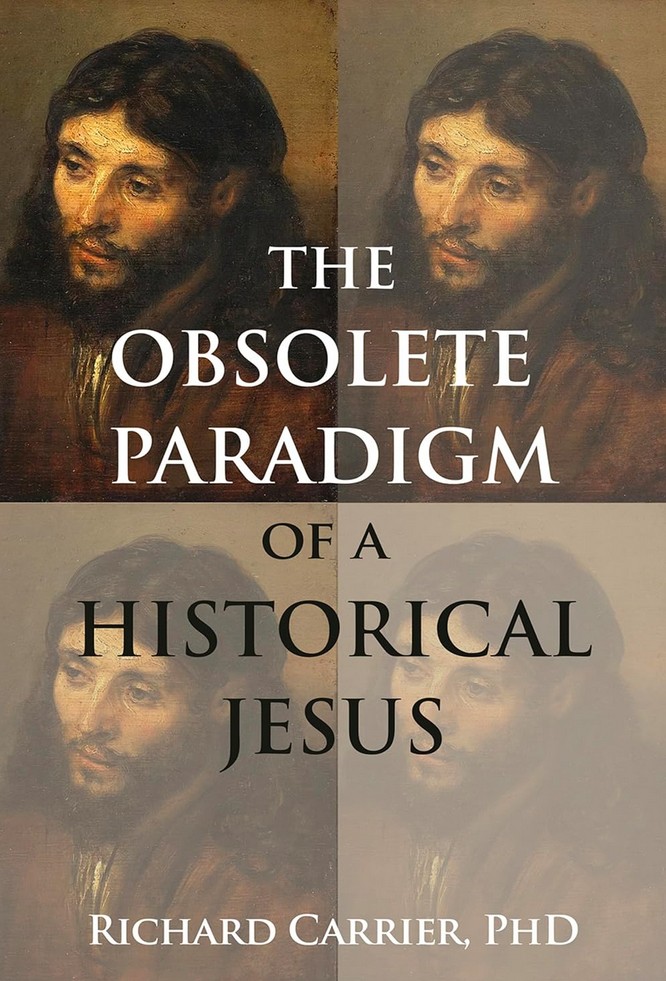
Richard Carrier’s new mythicist book about the historical Jesus

I finished reading Richard Carrier’s new book, “The Obsolete Paradigm of a Historical Jesus,” a couple of days ago. It did change my mind about the relative merits of the theory Jesus was only seen in visions versus the theory that Jesus was a real person. The evidence I thought was the strongest for the latter theory, passages in the letters of Paul suggesting he thought of Jesus as historical, is more ambiguous than I believed. The passages were those indicating Jesus was “born of a woman, born under the law” (Galatians 4:4), saying Jesus was of the Jewish race “according to the flesh” (Romans 9:5), and referencing “Jame, the brother of the Lord” (Galatians 1:18-19). Carrier’s arguments about those passages are very detailed and as far as I can tell sound.

I am not yet ready to lean definitely toward the mythicist position, but I do want to think this through more carefully. When I first looked into the work of Carrier and other mythicists about 15 years ago it left me doubtful that anything about an historical Jesus could be recovered. Subsequently I set aside my interest in the subject for a while. I have to admit that in the meantime my mind reverted back to the assumption Jesus was historical, probably less due to intellectual conviction than because that assumption had been part of my imagination for so many years.

My page on this site about the historicity of Jesus will have to be revised. My arguments there no longer seem sufficient to wave aside the mythicist position so easily. But I will keep my other pages mostly intact for now. What I intended with this website wasn’t really about whether Jesus was historical, although I am interested in the question. What I intended was to assess what the teaching of Jesus was. I want to do that both for its contribution to my own spiritual life, as the gospels have inspired me since I was a child, and as a means of discussing what look to me like erroneous versions of his teachings.

I will have to approach that question differently than I had planned though. Rather than trying to excavate a presumed teaching behind the various sources about Jesus, I’ll examine his teaching as presented by various authors, such as Paul and the authors of the four canonical gospels. Whatever points the sources have in common will be of interest, whether Jesus was historical, the product of visions, or a literary character of longstanding cultural influence.

So that is where I am at now. I’ll do a bit of rewriting of the current pages to clarify my intentions, and then resume my explorations into the endlessly fascinating topic of Jesus and the origins of Christianity.

Elaine Pagels’ new book; plus another argument vs. “mythicism”

Over the last couple of days I tore through Elaine Pagels’ new book, Miracles and Wonder: The Historical Mystery of Jesus. Pagels is well known for her work on early Christianity and especially her work on the Gnostic Gospels found at Nag Hammadi. The new book is meant as a culmination of her reflections about Jesus, both as a scholar and as a human being long interested in spirituality and religion. I always enjoy reading about someone else’s spiritual journey and how it may have points of intersection with mine. Miracles and Wonder is an easy read, aimed more at the general public than at scholars.

Nothing in the book changed my mind about Jesus as an historical figure, although there was some information I wasn’t aware of. I will have to go through it again more carefully and take note of points of special interest. I did notice she still talks about the Christian “communities” that the writers of the gospels were supposedly addressing, without mentioning new research such as that of Robyn Faith Walsh showing how the authors more likely were addressing a literate audience curious about Christians. Walsh did not appear in her bibliography.

I was also surprised to see her name check the late Jane Schaberg, a former professor of mine at the University of Detroit when I was an undergrad majoring in Religious Studies. Pagels relates how she and other scholars of early Christianity ignored Schaberg’s 1987 book The Illegitimacy of Jesus: A Feminist Interpretation of the Infancy Narratives, because they assumed the book was a “hostile polemic,” but that she regrets now that hasty assumption. I read the book about twenty years ago, during an earlier phase of my periodic immersion in questions on the historical Jesus, and found it, as I expected, to be a work of careful scholarship. I know from Schaberg, who I became friends with, that she received hate mail and death threats from people on account of that book.

So I recommend Pagels’ book as worth reading as a kind of combined spiritual autobiography and summary of widespread views among scholars about Jesus from an historical perspective. It doesn’t break any new ground or go very deeply into any topic, but is of course well informed on them.

On a different topic, I added another point to my list of reasons for rejecting mythicism and holding that Jesus was a real person. This is that Paul refers to Jesus as “born of a woman” and as a Jewish man “according to the flesh.” He certainly sounds like he thinks Jesus was a human being. I also rearranged the order of my several reasons to put what are probably the stronger arguments first.

Alan

Additions regarding mythicism and the Temple incident

I just finished revising several pages of the website in line with what I had to say in my last post about how a book by Robyn Faith Walsh overturned my picture of how the gospel authors created their compositions.

This was important because I want to make the strongest case possible for what really happened without relying on contested assumptions. Walsh (and other authors) have put in question the idea that the gospel writers were writing within and for particular communities of early Christians, relying on stories passed down in those communities. Rather, there is evidence the authors were addressing literate audiences, both Christian and non-Christian, and relying heavily on literary sources and tropes of the time.

The biggest change from this was on my page about the execution of Jesus. I deleted the passages about how the narrative of Jesus’ final days showed particular signs of oral transmission, an argument which I now regard as less convincing. I still think a story was handed down orally, but that Mark probably invented many of the memorable details.

While revising that page I also expanded the sections on Jesus’ cleansing of the Temple, adding new material that helped fill out what historical information I think we can take away from this story.

I made change to the page on Jesus as an Historical Person (formerly titled Jesus in History) as well, moving my objections to mythicism–arguments that Jesus was purely mythological and not a real person–to the beginning and clarified some of my points. I did this because mythicism seems to have a large following these days and I wanted to address it up front.

That’s it for the revising, now I can return to my draft of the next page for the site. This one is about the ideas Jesus’ disciples drew from in order to make sense of his death and the “appearances” of Jesus that followed his death. I look forward to sharing it with you.

As always, you can make comments on this blog post regarding the changes I outlined above.

My picture of how the gospel authors worked has been overturned

I just finished reading a book by Robyn Faith Walsh, The Origins of Early Christian Literature, and it has overturned one of my key assumptions about the gospels: that they are to some meaningful extent based on oral traditions about the historical Jesus. This suddenly brought me back to where my thinking was about 15 years ago when I last delved into recent works on the historical Jesus: that it is impossible with the materials at hand to say much of anything about Jesus as a real person. We only have evidence for him as a figure in literary works.

At that time the field of gospel studies was showing multiple parallels between the incidents depicted in the gospels and earlier Jewish and Greco-Roman texts, demonstrating at least that the gospel authors borrowed liberally from other textual sources to compose their works. At that point I decided that Jesus as an inspirational figure, whether as real as Mohandas Gandhi or as fictional as Sherlock Holmes, was sufficient for the purpose of living my life.

But I must not have fully absorbed the implications of that, as I still held unto the idea that the gospel writers probably used some oral sources about the real Jesus. They shaped them to fit their purposes and inserted them creatively into their narratives and we can’t easily recover them, yes, but we can make some important educated guesses, can’t we?

I am not sure. What Walsh offered me was a different account of how the literary borrowing worked, based on what we (she, not so much me) know about the production of other literary works at the time. In the “bios,” or lives of notable people, authors usually drew from other written sources and utilized familiar tropes. It was from a video of Walsh speaking about this that I first became aware of the empty tomb trope that I reference in my page on the resurrection.

After reading her book I now have in my mind a different picture of how the gospel authors worked than the one I had long held and been unable to shed. Rather than working within Christian communities to gather and rework oral traditions to advance theological agendas, they read other texts and addressed a wider literate audience not only to advance a theological agenda but to challenge prevailing norms, satisfy curiosity about other cultures, and even to entertain.

The upshot for me is that I want to go back over my writing on this site to date, especially the pages on Jesus and History and the Execution of Jesus, and be even more cautious about my assessments of the likelihood that particular events happened. I have been unsatisfied with my use of the term “near certain” anyway, because even though I tried to qualify it the term still seemed to suggest some degree of unassailability to my conclusions. So I will replace that term with “very likely” in my rewrites.

To my relief, in a video interview released just yesterday Walsh did say she believes at least one fact about the historical Jesus: that he was crucified. So something can be said. I do think we can go beyond that, even if not as far as I hoped. It will be interesting for me to try to sort that out with this new picture in my head.

A final word here that may clarify what I am up to. A friend mentioned to me his (not uncommon) view that accepting the core claims about Jesus is important as a matter of religious faith and not on the basis of tenuous historical findings. I can accept that view, but I am not exploring this topic as part of a search for something to believe in. In large part I am motivated by the hope that both believers and skeptics of Christian claims could at least agree on some points of what Jesus was about, given how our culture is currently riven in large part by efforts to claim the sanction of Jesus for political agendas. The other part of my motivation is my desire to see if my own spiritual orientation–which I have no desire to change, although I am open to it–can fit within Christianity, at least insofar as I understand that term.

As always, my thanks to those of you engaging with what I write here.

Alan

Why didn’t this occur to me?

In a post a few days ago I mentioned that both Luke and John tell the story of Peter returning to the empty tomb to see it for himself, and that it caused me to question whether John knew one at least one of the synoptic gospels, the gospel of Luke. I was working on the assumption that John did not know the synoptics, therefore he and Mark must have been drawing from an independent narrative known to both.

My thinking was this. If Mark did not know the story of Peter returning to the tomb, it couldn’t have been in the earlier narrative. Then how did John know it? He must have gotten it from Luke, therefore John at least knew the gospel of Luke. Right?

Wrong! It occurred to me today that there was a simpler explanation. An early copyist of the gospel of Luke added the one line telling the story of Peter to harmonize it with the story in John. I checked and sure enough, the line (Lk 24:12) is not found in all the early manuscripts. It doesn’t look like there is a consensus on whether it was in the original Luke, but it is certainly possible, and to me likely.

So I wasn’t on my toes when first thinking about this. The good thing is that it did send me looking into more recent research on the independence of John from the synoptics and finding that the experts’ views on this have been changing over the last decade or so. As a result I am being more careful about the idea that John and the synoptics represent independent attestation of an earlier narrative, an example of where my previous knowledge has become outdated.

I didn’t expect to be posting so often, so I hope you don’t mind. I am learning new things as I work on this website, and thought my subscribers would like to follow along and perhaps learn something new themselves.

More on the Temple event and the death of Jesus

Over the weekend I was a virtual attendee at the New Insights on the New Testament Conference 2025. I saw four good presentations by outstanding Biblical scholars, and one half a good presentation when the presenter’s internet connection from Europe lagged too much to understand him.

Two of the presentations were particularly relevant to my page on this website about the Execution of Jesus. Paula Fredriksen gave a thorough discussion of the episode of Jesus’ disruption at the Temple. Helen Bond talked about the last 24 hours in the life of Jesus. I was gratified that neither of these presentations conflicted with the findings on my page! I did slightly revise the page and added a bit of new material to it in light of what they had to say.

Helen Cook emphasized that we don’t know for sure that the Jewish council that condemned Jesus was an official gathering of the full Sanhedrin, and that Jesus’ hearing before Pilate was not a formal “trial” in the way we are accustomed to think of them. Pilate could have condemned Jesus simply on the basis of reports about him if he deemed it necessary; he brought Jesus in for questioning to get a better sense of the person he was dealing with.

I thought both points were sound and so revised my page to remove references to the Sanhedrin and to change the word “trial” when it appeared to “questioning” or “hearing.” Small change but I don’t want my page to have even small inaccuracies when I become aware of them.

Paula Fredriksen had a lot to say about Herod’s Temple and how it functioned. She doubted that Jesus would not have been arrested right away if his disruption actually happened, as there were soldiers watching everything from easy vantage points around the court of the nations where the financial transactions were taking place. As the gospel accounts of the incident conflict on when it happened–John moved it way back to the beginning of Jesus’ public life rather than at the end–she regards it as a separate story from the narrative of Jesus’ final days which the gospel authors placed where they did for literary purposes. Specifically, she suggested Mark inserted it between Jesus’ entry into Jerusalem and his arrest as a transitional device between Jesus’ conflict with Pharisees in Galilee and his conflict with the high priests in Jerusalem. She said it made more sense for Jesus to be arrested quickly after his entry into Jerusalem to avoid any potential problems before they happened. She also used this to explain why Jesus’ disciples were not also arrested.

I thought that was an interesting suggestion and incorporated some of it into my own discussion of the arrest of Jesus, as you will see if you take another look at the final paragraphs.

Unfortunately, none of the presentations were on the resurrection, which I am currently working on. Yeah, I know I keep promising it will soon be ready to publish, but it is getting close. Stay tuned.

Alan

The independence of the gospel of John

Well, here I am posting again much sooner than I thought I would.

I changed my mind about something important while researching the gospel accounts of the discovery of the empty tomb. That led me to do some revision of my already published page on the execution of Jesus, so I wanted to let you know about that change and why I made it.

In writing the page on Jesus’ execution I relied on my memory that the majority opinion of Biblical scholars was that the author of the gospel of John did not know the synoptic gospels (Mark, Matthew and Luke), although there was still a lot of dissenters from that opinion. Looking into this the last day or so, it seems a consensus is emerging that John DID know of the synoptics. The upshot is that I should not treat John as an independent source for the events of Jesus’ life and death.

And life after death! The thing that caught me while comparing the gospel accounts of the empty tomb was that Luke and John say Peter inspected the tomb but Mark and Matthew do not say this. I could not think of a reason why Mark would neglect that story if he knew of it, or why both Luke and John would insert it–unless John knew the gospel of Luke.

Thus a hurried search of current academic opinion on John’s independence, and my realization that I had relied too heavily on my assumption that there were two sources for the story of his execution. I revised that page but found that this new insight did not change my main conclusions.

By the way, I am about two-thirds of the way through a draft of my soon-to-be published page on the resurrection. It’s taking longer than I thought because I keep noticing and discovering new things, so I guess that is a positive.

Onward!

Alan