Hi there. Honestly, I didn’t go into this study of the resurrection of Jesus with a desire to confirm either that it did or did not happen. I wanted to make the strongest case possible against it to see how well that case stood up. Depending on how strong it seemed, the resurrection would be either more or less defensible. My own viewpoint was that I had no idea what really happened, but it would be nice to have my mind more settled on the question.
Well, as a result of all of this reading and thinking my viewpoint is shifting. Not that I think there is proof, but that I think it is intellectually defensible to believe that Jesus really appeared to some of his disciples in some kind of bodily form after his death. Of course, that requires more than an analysis of the evidence to accept. It requires a worldview which won’t suffer too much violence to fit in such an event.
Here are a few of the things that made a difference.
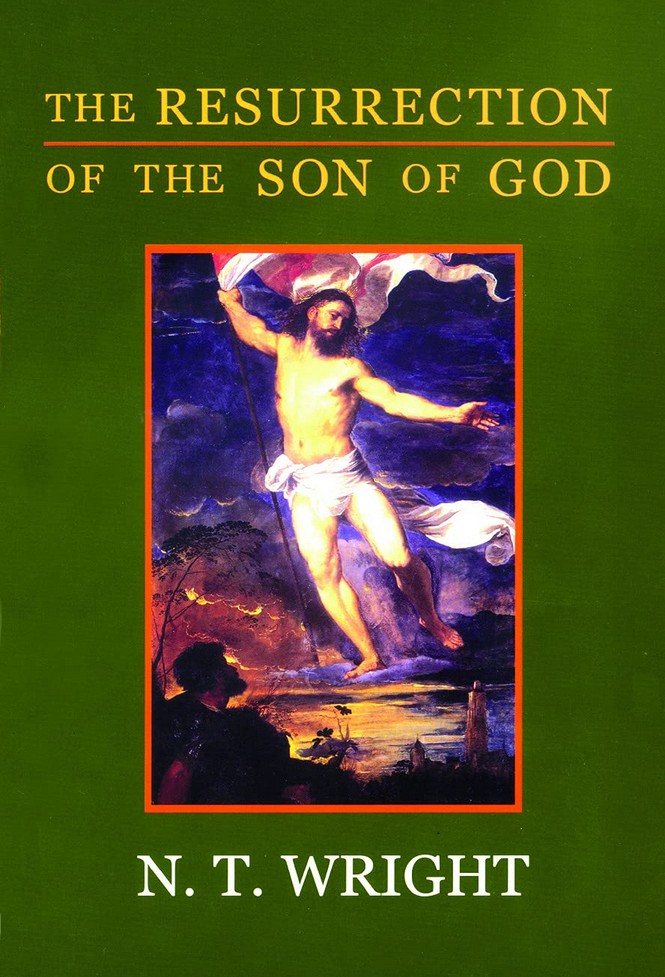
N.T. Wright, in his (massive) book “The Resurrection of the Son of God,” asks the question: how can you explain the early Christians’ adoption of the idea of a two-stage resurrection–first Jesus, then everyone else–unless the disciples were absolutely convinced that they saw Jesus again after his death? Most first-century Jews seemed to believe in one resurrection, the one with everyone at the end of the age. How did the two-stage idea come to be?
His answer is that it could only have happened if they were absolutely convinced Jesus rose from the dead, even though the rest of the deceased were not yet showing up. And they would only be convinced by both the empty tomb and the multiple appearances of Jesus. One without the other would not be enough. An empty tomb would be a mystery. Appearances would be visions, like the frequently reported visions of a dead person that people do have. Only both meant a resurrection had happened.
I am not sure that argument holds up. I think an expectation that the general resurrection was imminent, plus the appearances of Jesus, would be sufficient for them to come up with a two-stage concept. But it did cause me to think about the oddity of the combination. Chronologically, it makes sense to me. First a belief that resurrection is about to happen, then the appearances, and you get a resurrected Jesus. But look at it in reverse. How likely is it not only that multiple appearances of the same dead person are reported (as in Paul’s First Letter to the Corinthians), but that a belief in an imminent resurrection happens to have been accepted by them beforehand?
That is what struck me. The widespread expectation of a general resurrection just happens to have developed among first century Jews before the disciples of Jesus start having visions of him? Strange historical happenstance. No other culture held such a view, expect maybe in Persia, although that is disputed.
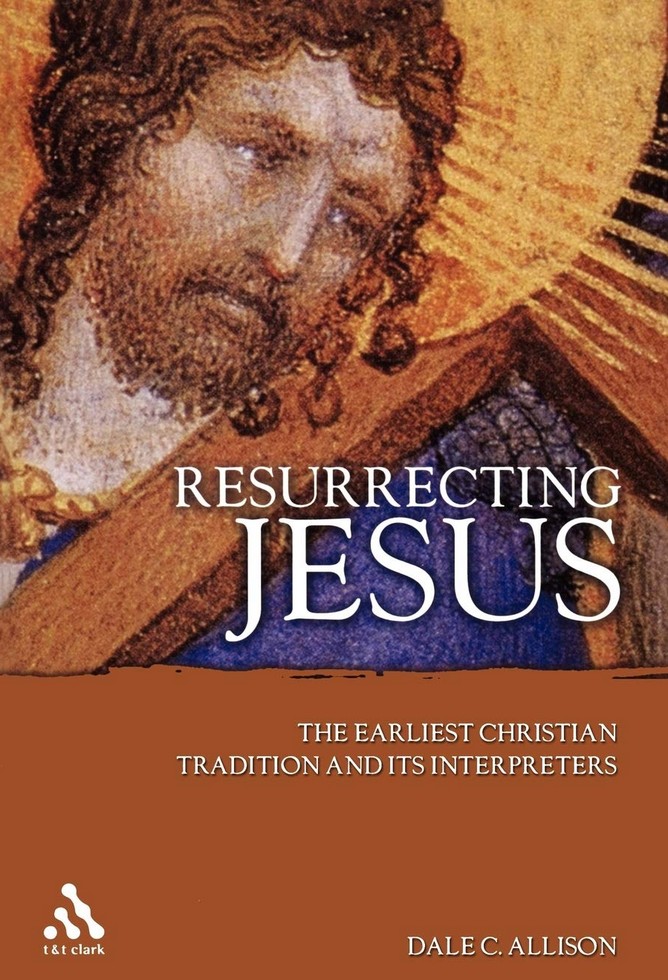
Just last night I finished Dale Allison’s exhaustive review of the literature on the resurrection in his book, “Resurrecting Jesus.” He presents a lengthy discussion of visions of the dead in modern times, with an abundance of footnotes. People have experiences of dead people present again. The deceased seem very real to them. Groups of people can experience this at the same time. Occasionally they not only see a deceased person, they touch the person. All that makes even the gospel accounts of Jesus’ appearances more credible.
That was not news to me. But what Allison also had was a discussion of the arguments pro and con the finding of an empty tomb. Up to now (and still on my page about the resurrection on my website) I have regarded the empty tomb story as a literary fiction by the author of the gospel of Mark. Allison presented a couple arguments that provoked me to rethink this. Part has to do with burial practices for crucified criminals (it was not uncommon to bury them) and part has to do with the reality of Joseph of Arimathea and Mary Magdeline and their roles in the drama. I am still in the process of thinking through these arguments.
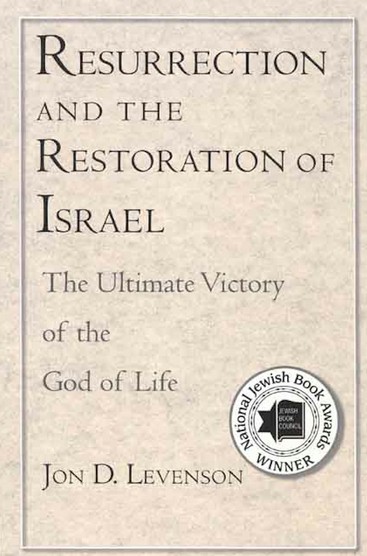
Finally, a few months back I read a book by a Jewish author, Jon D. Levenson, “Resurrection and the Restoration of Israel.” Levenson wasn’t writing about Jesus. He was defending the belief in the general resurrection as compatible with Jewish beliefs before the period of the Second Temple. For example, belief that creation is good, that God intends justice to be done, and that human life matters. All of these are beliefs I share, so his presentation made me want to believe in a bodily resurrection. His book shifted me from seeing resurrection as irrelevant to how I live my life, to an important potential buttress to beliefs I already hold dear. I think that prepared the ground for me to be more open as I considered the question. It wasn’t only about belief in what really happened at the start of Christianity, it was about how that belief could fit in with a worldview I already hold.
So that is where I am at. I am about done with reading and about to start writing up my thoughts, which is going to take many more pages than I currently have up on this site. I will let you know as I get the new pages up.
Thanks for your interest.
–Alan


Hi Alan,
I really appreciate the depth of your reading and the sensitivity of the thoughts expressed. Unfortunately I can’t get anywhere near as close to the tentative conclusion that you do. (Maybe I should read all the books you have!)
Here’s my thoughts on what you have just laid out.
I haven’t read N.T. Wright (mainly because I find his video commentary on other issues lacking) but does he really think “the disciples were absolutely convinced that they saw Jesus again after his death”? All of them? Can he account for all the beliefs and experiences of all 12-14 disciples? (I say 12-14 as the names differ among the gospels). And how does he account for Matt 28:16-17 “Now the eleven disciples went to Galilee, to the mountain to which Jesus had directed them. 17 When they saw him, they worshipped him; but some doubted.” Some believed on the basis of a fuzzy image on a mountain top, others didn’t.
Does he rely on Luke and John to get the doubters there – they didn’t believe on the mountain but were later convinced with the meals and wounds and other physical appearances? These two gospels don’t reference Matthew or a mountain top experience, their recitation of events is very different, so I see the two as inconsistent.
As for the two stage idea, Paul covers that. Christ was the first fruits, the initial one. The rest were to follow very soon. The end times were imminent.
And I think you hit the nail on the head when you observe that first a belief that resurrection is about to happen, then the appearances, and you get a resurrected Jesus. There was a profound and emerging idea that the end times were near, that the end of world resurrection was imminent. This was developing in the area well before Christ was born and appeared to be fairly prominent by the time he did. Eg, Herod thought that Jesus was John the Baptist resurrected.
That is to say, it is highly unlikely in my view that the resurrection appearances preceded the belief in a resurrection, as I think your exhortation to “look at it in reverse” suggests (although I was not clear on what you meant by that paragraph).
I find it highly possible that, in an atmosphere of expectation of the end times’ resurrection, people will start seeing resurrection occurring. Add into the mix an apparently charismatic figure and the popular imagination will soar over the decades following his life. And this may have been unique to Israel, but that does not make it a “strange” historical happenstance, it is simply a historical happenstance.
This time lag is important. The gospels are written decades after Jesus’ life. As is Paul’s list in 1 Cor 15. The problem with I Cor 15 is that we only have Paul’s record of it. There are no names of the 500, only the story that many are still alive. He doesn’t say he has spoken to them. At most we can say that he was told there were 500 and some alive.
Then he says Jesus appeared to Peter and the twelve. From whom did he get this? At best, from Peter whom he visited in Galatians. But what did they say? We have nothing from any of them. (And all twelve? Again Matt 28:17 – he may have appeared to them all but not all believed).
Nor is it clear what Paul saw. He had a visitation of some sort, told in differing ways in Acts (is that reliable?), but not told in detail in his own letters. I suspect Paul is interpreting the experience of others in light of his own experience. Peter may have said I believe Jesus is risen (based on the general apprehension of the resurrection prevalent at the time) – or I hope he has, or it is possible that – or I heard that …
We just don’t know what the disciples thought, whether it be Peter, with whom Paul met, or any of the others who have no interaction with Paul at all, and who disappear from the narrative as time rolls on.
So by the time the writers put pen to paper (Paul and the gospellers) decades later, the germ of the idea that might have been around closer to 33 AD has grown into something much greater. Stories of appearances, details of meals, fingers in wounds. Mark simply says go to Galilee. Ie, he’s heard of the rumour, but can’t figure it out. Matthew says some believed, but can’t so who, and (on the basis that the author was not a disciple) was not there. Luke and John embellish. Luke is stuck in Jerusalem, directly contradicting the others, and both he and John seem to be writing to convince an audience, which detracts from the authenticity of the narrative.
N.T. Wright’s argument that the empty tomb is essential to the belief in the resurrection does not prove the empty tomb was a fact. He assumes it was (this is where I find him lacking – he does not question his sources). Sure the empty tomb is used as a justification for arguing that Jesus had risen, but who knows where the empty tomb story arose? The tales are contradictory in the three gospels that relate it.
This inconsistency, combined with the time lag in writing, lead to the better conclusion that the empty tomb is a post hoc argument for the resurrection: we believed it happened, and stories of the empty tomb appear. Just like we believe in the imminence of the resurrection and end times, so the stories of it occurring take off.
Doesn’t Dale Allison hold the view that we cannot know what happened on the Easter night with any certainty at all? But for the purposes of your blog his review of sightings does not, in my view, make the gospel accounts of Jesus’ appearances more credible. It makes them less credible.
Sure, they may have earnestly believed Jesus rose, and (if we interpolate Paul’s view on to theirs, as we do not have theirs) Jesus was the first fruits of the forthcoming imminent universal resurrection event. But that belief is not a credible one. And studies in the human phenomenon of post death experience adds to its incredibility.
I am curious as to why Levenson’s analysis of prior Israelite beliefs that creation is good, that God intends justice to be done, and that human life matters, inclines you to want to believe in a bodily resurrection. These beliefs (in human value, justice and the goodness of creation) were prevalent in ancient Israel well before the idea of a resurrection began to develop. There was no afterlife prior to the Second Temple (other than the sombre Sheol), and the idea of a resurrection only really took form after Daniel and the inter-testament era, fostered in part by the Essenes, but probably by others as well.
So they don’t seem particularly linked to, or bolstered by, a bodily resurrection. They were valuable sentiments to the Jews without a bodily resurrection.
Again, I thank you for your work and continuing thoughts on these intriguing matters. I think a profitable avenue for investigation would be the time line for the writing of the records we have – Paul (probs 50’s) and the gospel writers (for whom I have not seen a great deal of exposition). This would help flesh out arguments on the reliability of the gospels.
Cheers
Rob
LikeLike
Hello again Rob. Lovely to hear from you again!
Yes, Wright regards the gospel accounts of resurrection appearances as based on real historical events. I won’t go into his arguments, as I did not buy them and am not sure I even remember what exactly he said about it.
I suspected my “look at it in reverse” comment was not too clear. What I meant was this. It is clear to me why appearances would be interpreted as a resurrection if belief in resurrection was already there, as I am sure it was. Looking in reverse would be asking why a belief in resurrection arose in that time and place before appearances of a dead Messianic figure took place. The adoption of that belief by Jews was itself unusual, let alone that it happened to set the stage for Jesus’ ministry and what followed. If one is inclined to believe God has a hand in history, this looks like God may have engineered the timing. Hope that was a little clearer.
As I suggest on the page on resurrection here, I think the tradition Paul handed down ended with Peter. I am inclined now to add “then the twelve,” for reasons I will give in my new write-up. But the rest, the 500 especially, sounds like hearsay.
As for the empty tomb, I still think Mark made it up. I will have more to say in my new write-up about what information I think he had to work with. My theory is highly speculative, just like all the rest, but I think it fits better than the others I know of. Allison’s review of arguments about it (not his conclusions) sparked some questions in me that led to my new way of looking at it.
If one accepts the modern accounts of seeing dead people, the question for me revolves around what it would mean for Jesus to have a “body.” Was his “body” different from that of other appearances, or did they all have some kind of “spiritual body,” as Paul puts it. I am inclined to think the latter, but confess I am still unsettled about it. That would make Jesus not unique, except for the symbolic weight assigned to his death and appearances. But the latter are important too.
Levenson’s summary of Jewish beliefs incorporated into the concept of a general resurrection made me look at the idea as an affirmation of my values rather than a question of whether it could really happen. If Jesus was resurrected though, God is giving it a seal of approval but kicking off the process. I don’t know exactly what happened back then, no one does, so I think folks are free to adopt whatever explanation helps them through life. In short, I think there are ways to defend the resurrection of Jesus that do not depend upon proving what happened, as long as no one is yet able to disprove the claim he was resurrection.
I am currently writing up my thoughts after all this research and hope to be posting them within the week.
Thanks for posting. –Alan
LikeLike