Okay, here’s another instance where I come across something that causes me to rethink everything I thought I knew about early Christianity.
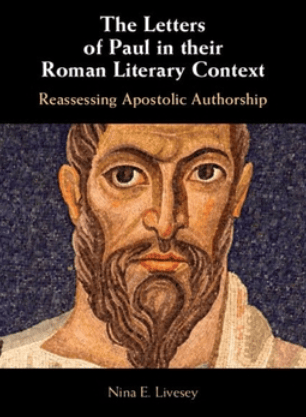
This week I saw a couple of interviews with Dr. Nina Livesey, author of The Letters of Paul in their Roman Literary Context. The most startling takeaway from these interviews was that the Apostle Paul may have been a purely fictional character and “his” letters actually produced by someone a century after Paul was supposed to have lived. You can watch the interviews on YouTube:
Luke Invented Paul the Apostle
The Apostle Paul and His Letters Were Fabricated?
Before watching the videos I thought I would be hearing a Jesus mythicist (who does not believe Jesus was a real person) moving into Paul mythicism. I was curious about her arguments as my research on the resurrection of Jesus has shown how central the letters of Paul are to this topic.
But she does not seem to have started from a position of mythicism at all, rather she as an expert on the letters of Paul who had some unanswered questions about them. As she laid out her thinking I found her arguments to be very strong, at least compared to the arguments that Paul’s letters were written by him only about twenty years after the death of Jesus. I already knew how tenuous those arguments were, as they depend on correlating the dating of the letters with the reliability of the history in the Acts of the Apostles.
My whole picture of the development of Christianity has now shifted radically, due to these interviews and some writing on Josephus I’ve been reading. The historicity of the Acts of the Apostles is called further into question, leaving the entire period between the death of Jesus and the writing of the gospel of Mark in the dark. Paul can no longer be assumed to be a first-hand witness of the risen Jesus. Nor can we rely on his tradition in 1 Corinthians 15 about the other witnesses to the risen Jesus.
The conventional view on dating the early Christian sources and their relationships to each other has been this:
50s: letters of Paul
70s: Gospel of Mark
80s-90s: Gospels of Matthew & Luke (both using Mark) and Acts of the Apostles
90s-100: Gospel of John
My view is tentatively now like this:
70s: Gospel of Mark
80s: Gospel of Matthew (using Mark)
70s-90s: Josephus’ writings (perhaps using Matthew?)
Early 2nd century: Gospel of Luke and Acts of the Apostles (using Mark, Josephus, and perhaps Matthew), Gospel of John (using Mark, Matthew & Luke)
Mid-2nd century: letters of Paul
As you might infer, this new timeline would require revising a lot of historical research on early Christianity. This would include the pages I’ve already written on the resurrection over the last year or so!
I intend to obtain a copy of Livesey’s book as soon as I can to take a look at her arguments up close, then to read some of reviews of the book. I will then have to decide if the new timeline holds up better than the old one, and revise this website accordingly.
Lot of work, but kind of exciting to find my picture of early Christianity changing almost week by week as I pursue this project. I will certainly keep you all posted.


Thanks, Alan! I so appreciate your sharing these!
LikeLike
You’re very welcome.
LikeLike
Thank you for doing all this work for me. I see that Bart rejects her theory, but Cornthwaite is open to it. Not surprising.
LikeLike
I will have to look for those. I am about a third of the way thru her book and so far it looks pretty solid to me.
LikeLike
I’m listening to this one now, where her theory is mentioned. https://www.youtube.com/live/Nora9p384qo?si=cSKr1Ls1Us4l6drJ
LikeLike