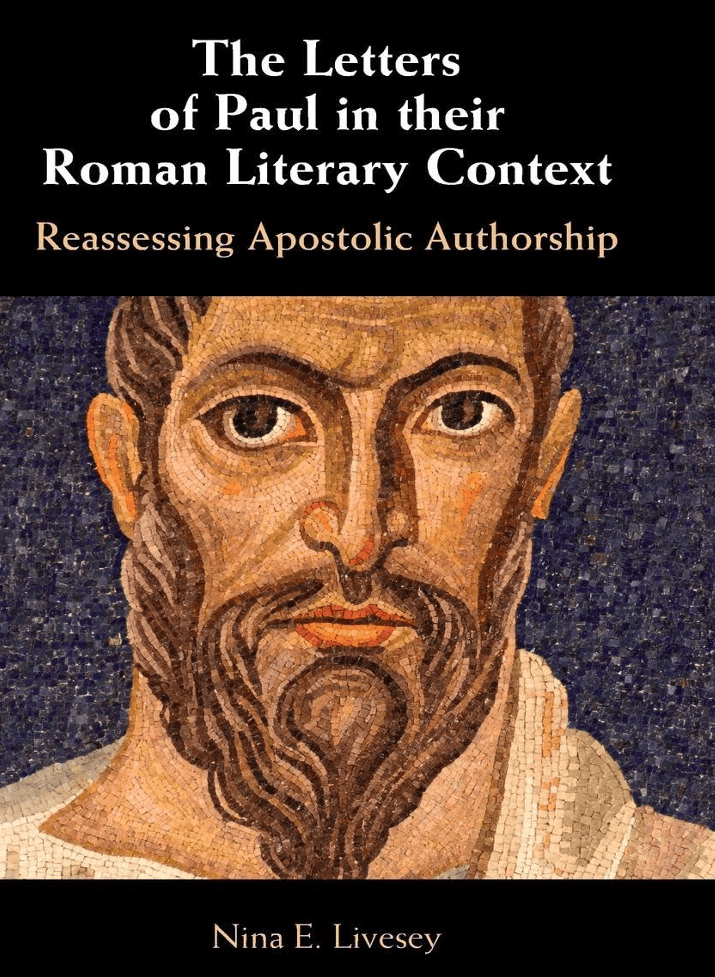
I recently finished reading Nina Livesey’s 2024 book, The Letters of Paul in Their Roman Literary Context. Her central thesis is that the seven letters of Paul widely considered by Biblical scholars to be genuine 1st century writings are instead pseudonymous compositions of the mid 2nd century. That is, the authors of the letters are pretending to be “Paul” and writing nearly one hundred years after Paul was supposed to have lived. She further argues that the likely location of the letters’ composition is the school of alleged Christian heretic Marcion in Rome. A huge amount of historical research on early Christianity would be overturned if she is correct, thus of course one would expect a lot of resistance to it.
As I noted in my previous post on her book, when I first heard of her thesis I was skeptical but intrigued. After listening to her in a couple of YouTube videos I was impressed enough to rethink my assumptions about Paul and early Christianity. It struck me that her thesis helps make sense of a couple of problems that I was already aware of.
The first problem is a chronology in which the letters of Paul precede the composition of the Gospel According to Mark, thought to have been written in the 70s of the 1st century. Paul’s letters have a higher Christology and more developed theology that Mark seems to have. It makes more sense to me that a relatively low Christology and less developed theology came first, thus Mark should have preceded the composition of the letters.
The second problem is a larger one: a chronology in which the letters of Paul precede the composition of the Acts of the Apostles, which narrates Paul’s missionary activity. If Paul was known to have written theologically dense letters that were so cherished by their recipients that they preserved them and shared them with other Christian communities, why does the author of Acts say nothing about Paul’s letters and depict speeches by Paul in which his theological views don’t match his letters? Doesn’t it make more sense that Acts was written first and the pseudo-Paul writers of the letters placed their theological embellishments into settings and situations derived from Acts?
And so I read her book. I found it to be well-documented, thoroughly researched, carefully argued, and persuasive. Her arguments against the conventional dating of the letters are, in my opinion, very strong. Her arguments for the origin of the letters in Marcion’s school are not quite as convincing, although, as she says, her thesis is a better fit of the evidence than the conventional view.
To further test her ideas I read and watched a few takes on her book from those with more expertise than me. Here the ones I found most useful so far:
Paula Fredriksen’s review delivered to the Society of Biblical Literature in 2025.
“The Letters of Paul: A Review of Nina Livesey’s New Book,” on M. David Litwa’s YouTube channel.
“Did Paul the Apostle Exist?! | Dr. Nina Livesey Vs. Dr. Bruce Chilton,” on the History Valley YouTube channel.
I also asked ChatGPT if Bart Ehrman had reviewed her book and learned he had not, but that he has comments regarding it scattered about his blog. I then asked ChatGPT to summarize his comments and it did so.
What I would say at this point is that these confirmed my initial reaction to her book. None but Ehrman take issue with her contention that a 1st century dating of the letters is weakly supported. Ehrman’s argument relies on one of the letters of Ignatius of Antioch to show early knowledge of Paul’s letters. But Livesey addressed this in her book, showing how the letters of the apostolic fathers like Ignatius and Polycarp also share the characteristics of pseudonymous “letters in form only,” which was a common genre at that time. Based on ChatGTP’s account of Erhman’s comments, I doubt he has read her book.
What they do take issue with is her alternative dating and location of the composition of the letters, and Fredrikson and Litwa make some very specific arguments here. A couple of examples. Fredriksen points out that Livesey mistakenly dates the destruction of the Jerusalem Temple, which actually happened in 70, not during the Bar-Kokhba uprising of the 2nd century, and that neither event resulted in widespread Roman antipathy to the Jewish law as Livesey states. Litwa questions why there is no evidence that anyone writing around that time expressed suspicion at the letters’ supposedly sudden appearance.
My view now is that the letters are probably pseudonymous “letters in form only,” but that producing a plausible alternative dating will require examining the contents of each letter in light of developments in the post-70 period. I no longer have enough confidence in the letters to use them as I did in examining the resurrection of Jesus, a topic I have spent much of the last year researching and writing about! I was almost done with that section of this website but now I don’t think I will finish it. The foundation of my account feels too shaky. (I will keep those pages up for the time being.)
Instead I am going to once again make a new start. This time I will interrogate early Christian history by starting with the gospel of Mark and trying to figure out where Paul’s letters best fit as I go on from there. I may find I am on the wrong track, but I am very interested in seeing if an alternative history can be produced.
What do you think?


I have trouble commenting on your blog site.
Carrier also mentions her theory: https://youtu.be/jWm7XmDHw7g?si=AhK1_krgyouecbGP
LikeLike
Is the trouble that your comment didn’t show up right away? I have to approve comments before they show up.
Thanks for the link!
LikeLike
Yes, plus I have to fill in all the contact info, ever time I comment, even tho I’m logged in. I just haven’t figured it out yet.
LikeLike
I changed the settings on comments so you should not have to give your name and email. If you have already had a comment approved, future comments should no longer need approval before showing up. Thanks for brining this to my attention!
LikeLike