(Nov. 1, 2026)
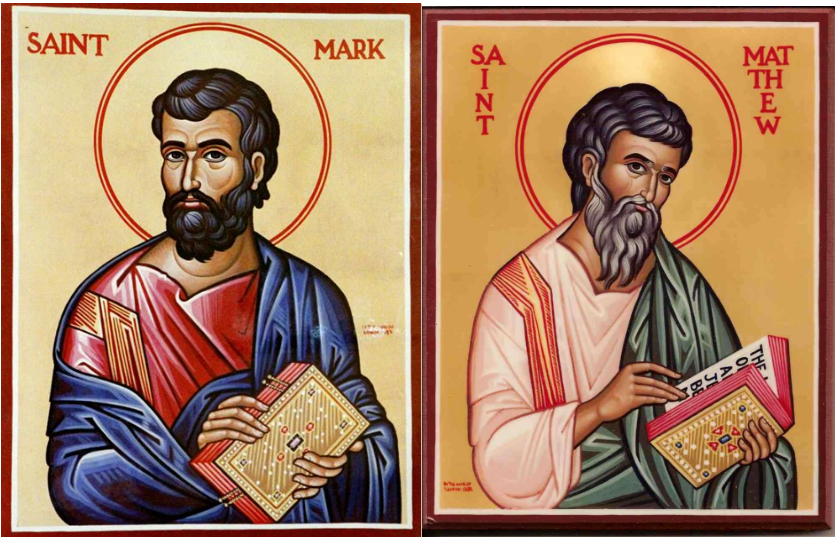
The first two primary source writings I will analyze have long been referred to as the Gospel According to Mark and the Gospel According to Matthew. Here I want to examine the genre of literature they fit and offer some initial considerations on the historical situation at the time of their composition.
Genre
A genre is a category of literature that has developed over time to the point where an author can use it to compose a writing in a form their intended audience will recognize. The point of choosing a genre is to aid the reader in interpreting it in a manner consistent with the author’s intentions. In our time a book about Abraham Lincoln will be interpreted differently depending on whether the reader understands its genre to be a biography or a novel, for example, Team of Rivals: The Political Genius of Abraham Lincoln versus Abraham Lincoln, Vampire Hunter.
The two writings at issue here have been described as euangelia, “gospels” in English, at least since the second century C.E. (The Greek word means “good news,” translated into Old English as “gospel.”) At that time the word referred to a message announcing some event to be publicly celebrated, such as a military victory or the enthronement of a new emperor. Christians adopted the word to describe their communications concerning the life, death and resurrection of Jesus. In short, a “gospel” originally was a term for an important message, not a literary genre. (Bond, 2020: 15-17)
The writers of these two books were conveying their understanding of the Christian message in a written rather than an oral form, raising the question of the literary genre they were using. Since the 1992 publication of the first edition of Richard Burridge’s What Are the Gospels?, his thesis that the canonical Christian gospels fit the genre of the ancient Greco-Roman bios has received wide support. (Burridge, 2004; Bond, 2020) A bios (roughly translatable in English as “life”) is a prose narrative focusing on the deeds and words of a particular individual, usually someone already well-known enough to provide the author an interested audience. Bioi (plural of bios) are medium-length writings in comparison to other literature of the time. They often have a chronological framing structure, starting from either the subject’s birth or entry into public life and ending with the subject’s death and its aftermath. Sandwiched between the beginning and ending are a variety of anecdotes, stories, sayings and speeches from various sources, usually organized in a more topical manner. Authors felt free “to select and edit sources to produce the desired picture of the subject” (Burridge, 2004: 198-199) and had a mixture of aims such as informing or instructing readers, preserving memories of the subject, and of course holding the attention of the target audience for the book. A major purpose of bioi of philosophers and similar teachers was to defend the subject’s character and teaching and to attack opponents of the same. (Burridge, 2004: 76, 208-210)
The gospels were written in koiné Greek, not the high literary style of Attic Greek, and we can assume they were aimed at a popular audience, probably including illiterate listeners, as written works were usually read aloud to groups of people. The gospel conventionally attributed to “Mark” (the authors are not named in the books) can be read aloud in under two hours. Popular bioi were “quite common,” although less likely to be preserved than bioi aimed at an audience higher on the social scale. (Burridge, 2004: 235) Such works were typically produced using the papyrus plant as a material rather than longer-lasting but more expensive animal-skin parchment or vellum, and in the physical form of a codex, in which pages were stitched together at the spine similar to modern books, rather than as a rolled-up continuous scroll.
Matthew Ferguson, in a 2015 conference paper and a 2016 blog post based on his paper, expanded upon the distinction between bioi aimed at a more educated readership and those aimed at a popular audience. The former he calls “historiographical” bioi, which identify their author and use sources critically. The latter, “novelistic” bioi, feature an anonymous author, an omniscient narrator, a description of direct speech, and the creative adaptation of both written sources and oral traditions, all of which are features of these two gospels. Did authors of bioi ever make things up? Koen de Temmerman, in his introductory chapter to a volume on fictionalization in ancient Greco-Roman biographies, states that ancient biographies “show a clear tendency to subordinate factual, historical truth to different aims,” such as communicating ideological, religious, moral, philosophical, or poetic truth, and that the “Lives of (contemporary and historical) intellectuals…are traditionally considered more imaginative than their political counterparts.” (de Temmerman, 2016: 5, 13) I infer that the gospels, as “novelistic” bioi of a figure who is more of a religious teacher than a political figure, would feature the use of various fictionalization strategies in their narrative so as to weave a compelling and positive portrait of their subject.
However, de Temmerman also cautions that the author of a bios worked within some constraints on this tendency. Their work must “inevitably refer, at least to some extent, to a preceding tradition of existing material, even if this material is of a legendary rather than a factual, historical kind.” (de Temmerman, 2016: 7-8) In other words, the author must bear in mind that their audience will already know something about the subject, and so take care not to contradict what readers presumably know unless providing plausible reasons why that knowledge is in error.
Historical context
The gospels of Mark and Matthew were not the only written “gospels” of Jesus circulating in ancient times, but they are likely the earliest in the genre of a bios. When they were written has long been in dispute. Surviving fragments of actual manuscripts of Mark and Matthew date no earlier than the second century; however, scholars mostly rely on internal evidence for the dating of the gospels. The leading position is that they were written after Roman soldiers destroyed the Jerusalem Temple in 70 C.E., as they show signs that the authors were aware of that catastrophic event in Jewish history. On the other end, Atkenson (2000: 100) argues that they were probably written before 115 C.E., as the authors show no sign of knowing about the Jewish revolts of 115-117 that took place in cities across the Roman empire, a topic that would have been of interest to them. As I will later discuss more fully, I date them after the destruction of the Temple in 70 and before the composition of Josephus’ Antiquities of the Jews in about 94. That Mark’s gospel was the earlier of the two is indicated by its shorter length and his less detailed references to the destruction of the Temple. The gospel of Matthew demonstrably includes about 90% of Mark’s text, although often in revised form, along with a significant amount of additional material not found in Mark. (Akenson, 2000: 106-107)
If this dating is correct, that means the gospels were written at least three decades after the prefecture of Pontius Pilate, who they depict as ordering the crucifixion of Jesus, and in a social environment radically changed from that earlier time. The war of 66-73/74 resulted in the razing of Jerusalem and destruction of the Temple, the center point of Jewish worship. Refugees fled Galilee and Judea, those who survived the Jerusalem siege were sold into slavery, properties were confiscated, and the Jewish governing structure of Judea ceased to exist. Early Christians, like the rest of the Jewish community, would have been distressed at the radical change in their political and religious situation. The gospels can be read in part as an attempt to explain the reason God allowed this to happen, centering on the death Jesus at the instigation of the Jewish governing elite. As witnesses to his life would have been dead or hard to track down, the authors of the gospels would have to rely primarily on oral reports about Jesus passed down to them, whatever useful written sources were available, and creative writing.
Conclusion
What we therefore should expect from the gospels is creative story-telling meant to make a point, especially to propagate their interpretations of the significant of Jesus’ life, death and resurrection. The authors may have made use of whatever factual information was available to them, but they would have felt free to shape the story and perhaps invent incidents in line with their literary objectives. This freedom is apparent in how Matthew copied from Mark while making obvious changes to it, as we shall see.
References
Akenson, Donald Harman (2000). Saint Saul: A Skeleton Key to the Historical Jesus. Oxford University Press.
Bond, Helen K. (2020). The First Biography of Jesus: Genre and Meaning in Mark’s Gospel. William B. Eerdmans Publishing Company.
Burridge, Richard A. (2004). What Are the Gospels? A Comparison with Graeco-Roman Biography, 2nd edition. William B. Eerdmans Publishing Company.
De Temmerman, Koen. (2016). “Ancient biography and formalities of fiction,” Ch. 1 in Koen de Temmerman & Kristoffel Demoen, eds., Writing Biography in Greece and Rome: Narrative Technique and Fictionalization. Cambridge University Press.
Ferguson, Matthew. (2015). “The Certamen of Homer and Hesiod and the Gospels of the New Testament: A Comparison of Biographical Genre.” Presented at the Pacific Coast Society of Biblical Literature, March 2016.
Ferguson, Matthew. (2016). “Greek Popular Biography: Romance, Contest, Gospel.” ἱστορία φιλοσοφία σκέψις website.

