In this post I start my analysis of the gospel accounts of the resurrection of Jesus, focusing first on the burial of his body.
“He was buried”
Mark’s scene of the women “looking on from a distance” at Jesus’ execution is plausible. (Mk 15:40-41) Crucifixions were public events that Jesus’ disciples could have attended, but fear of arrest would have kept his male disciples away. Women however were expected to be present when someone close to them was dead or dying in order to carry out expected customs such as weeping and singing formal laments. (Corley, 2002: 114-115)
Three of these women are named, as though Mark expects they may be familiar names to some of his reader/hearers. Mary Magdalene makes her first appearance in this passage. Her name suggests she was from Magdala, a fishing village on the northwest shore of the Sea of Galilee. Mark depicts Jesus’ early ministry as occurring in the area around the sea and describes his first disciples as fishermen, thus Magdalene’s name connects her to the early ministry. (Corley, 2002: 33) Mary the mother of “James the younger and of Joses” is not identified further, but earlier in the gospel Mark gives the same two names to brothers of Jesus and so this Mary may very well be Jesus’ mother. (Corley, 2002: 35) Possibly Mary’s son James is called “the younger” to distinguish him from Jesus’ early disciple James the son of Zebedee. One might question why Mark would not have said outright that this Mary was the mother of Jesus; it’s possible that this was another Mary who had sons with the same names. There is also the question of why he would list Mary Magdalene before her. Each of these details may have something to do with a need to highlight Mary Magdalene, even if it entailed downplaying the presence of Jesus’ mother, because Magdalene presumably played a central role in a tradition Mark was relying on. Mark says nothing to identify Salome; nearly half the women in the ancestral Jewish homeland were named Mary or Salome. (Corley, 2002: 32, 36) Likely Mark knew a woman named Salome was at the crucifixion but did not know anything about her. The abrupt introduction of these women, given Mark’s general lack of interest in women disciples of Jesus, suggests that their presence at the crucifixion may have been well known enough to early Christians that Mark wanted to use them as witnesses to the crucifixion and, more importantly, to the events that followed. (Corley, 2002: 28)
Less plausible is the passage about Joseph of Arimathea, who is otherwise unknown to history, and his interaction with the Roman prefect Pilate. (Mk 15:42-46) If “evening had come” there wouldn’t be enough time for Joseph to make his request to Pilate, the centurion to verify Jesus’ death, and the body removed from the cross and entombed before nightfall. These incidents would have to had occured earlier in the day. This could merely be clumsy writing on Mark’s part; I assume by placing the incident at evening he wanted to emphasize the body was removed before night came and the Sabbath began. Aside from that, I question the source for the story. Certainly Pilate did not talk to the early Christians about it. Joseph could possibly be the source, as Mark describes him as “waiting expectantly for the kingdom of God,” which could hint at some sympathy with Jesus’ disciples that led to later contacts. But this possibility conflicts with Mark’s description of Joseph as a respected member of the Jewish council that unanimously condemned Jesus and delivered him to Pilate for execution. Could Joseph condemn Jesus to death at a nighttime council meeting and the next day be so sympathetic to the Christian movement that he would go “boldly” to Pilate to ask for the body? In addition, the fact that Mark feels the need to explain who Joseph is suggests he did not expect his audience to be familiar with him. In sum, there is little evidence in Mark’s description of Joseph to support the idea that he was the source for the scene with Pilate. Did Mark know Joseph played a role in removing the body because the women recognized him and passed this bit of information down in the Christian community until Mark received it and expanded it into the scene with Pilate? I think it unlikely the women would have recognized him, as Joseph is a depicted as a high status Jew living in Jerusalem and the women are from rural Galilee.
The various problems described above suggest to me that Mark created a short fictional scene with Joseph and Pilate to achieve a few literary goals. First, the scene explains why Jesus’ corpse was removed from the cross, which I regard as a likely event as will be explained below, and does so in a way that legitimizes belief in (and foreshadows) the coming “kingdom of God.” Second, the centurion checking on Jesus provides confirmation that Jesus’ death actually happened. Third, the women witnessing the body being laid in the tomb and the stone being rolled against the door sets the scene for the discovery of the empty tomb when they later return to the location.
Although many commentators have questioned whether Pilate would have consented to the removal of Jesus’ body from the cross, this part of the story is within the realm of plausibility. Jesus’ death is portrayed as taking place during the Passover festival and there is some evidence that Pilate granted such favors on these occasions. (Lüdemann, 2004: 61-62; Allison, 2005: 360-363) A passage in a book by the first-century historian Josephus indicates that prior to 68 C.E. it was common practice for the dead bodies of the crucified to be removed for burial before sunset. (Licona, 2010: 308-309) Rather than having sympathy for the Jesus movement, one or more of the Jewish leaders could have requested permission to remove the body from the cross in order to honor the Sabbath and/or obey the law in Jewish scripture:
When someone is convicted of a crime punishable by death and is executed and you hang him on a tree, his corpse must not remain all night upon the tree; you must bury him that same day, for anyone hung on a tree is under God’s curse. You must not defile the land that the Lord your God is giving you for possession. (Deuteronomy 21:22-23)
Their intention would be to avoid defilement of the land, not to give the deceased a decent burial. Pilate could have consented to have the body taken down in order to maintain cooperative relations with the Jewish leaders and to avoid civil unrest while Jerusalem was crowded with Jewish subjects during a religious festival, especially one that commemorated their ancestors’ release from slavery to a foreign nation. Possibly Joseph of Arimathea was a real person known as having been a member of the Jewish council and Mark appropriated his name for verisimilitude in his description of the removal and burial of Jesus’ body. In any event, the exact identity of the person or persons who removed the body from the cross is not as important as its likely removal.
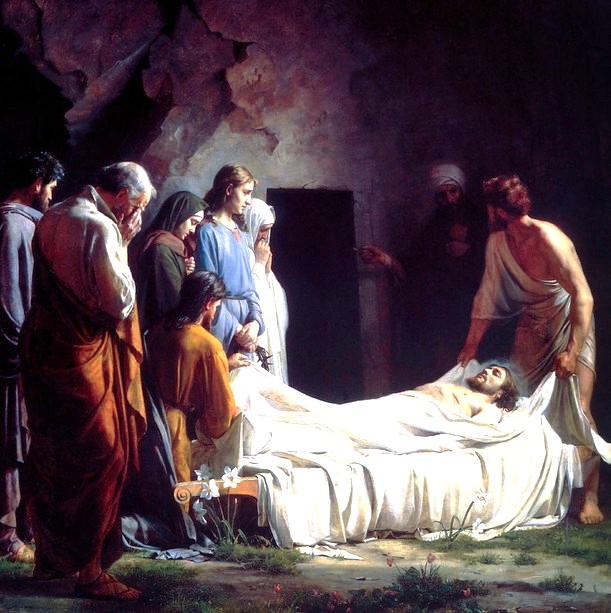
Mark winds up this part of his story by saying that Mary Magdalene and Mary the mother of Joses (leaving out mention of her son James for no apparent reason), two of the group of women present, saw where the body was laid. (Mk 15:47) This brings up further questions. Did the other women leave before the body was buried? Were the two Marys the only ones who cared enough to stay to the end? Perhaps the group of women agreed it would be less obtrusive for just two of them to follow the body to the burial place. Yet the tomb seems very near at hand, as Joseph is depicted as taking down the body, wrapping it in a linen cloth, and placing it in the tomb as though this was a set of actions unbroken in time. If that were the case, why would someone have carved a tomb so near to the site of crucifixions? It would not seem to be an appropriate resting place for oneself or one’s family members. The short verse about the two Marys creates a number of problems, but note that it also conveniently reduces the number of witnesses for the body being laid in the tomb to only two (and of course Joseph).
Mark seems to imply that Jesus’ corpse was the only one in the tomb by the way the “young man” later expects the women to recognize “the place they laid him.” (Mk 16:5-6) I am skeptical that this was the case. Jesus was crucified as a rebel against Roman rule, and Pilate would not want to allow any chance for the burial site of such a man to become an inspirational symbol of resistance and thus undercut the warning crucifixion was meant to convey. (Corley, 2002: 113-114, 118) Lüdemann posits that Mark’s story of Joseph of Arimathea placing the body in a tomb was a way of covering up what may have been a cursory and dishonorable burial, such as being dumped in a pit with the corpses of other executed criminals. (Lüdemann, 2004: 59-62) Allison, however, states that “burial caves” were set aside for criminals, which may be the kind of “tomb” Mark is referring to. (Allison, 2005: 263) I expect that such caves were meant for the disposal of multiple corpses, not “hewn out of rock” for the disposal of a single criminal’s remains.
To sum up my analysis of Mark in this section, I do think an oral tradition was behind Mark’s narrative in these passages. The tradition probably came from the women witnessing Jesus’ body being removed from the cross and reporting this to other disciples. Mary Magdalene was prominent in the tradition for some reason, which I will discuss below. The women’s report would be an adequate explanation for the early formulaic tradition, evidenced in Paul’s letter to the Corinthians, that Jesus’ body was buried. Burial could be inferred from the fact that the body was removed from the cross rather than being left to rot and be scavenged by animals as was the fate of most crucified criminals. (Licona, 2010: 307) The passages about Joseph of Arimathea, both his interaction with Pilate and his placing Jesus’s body in a tomb, I regard as mostly or entirely fictional. Mark’s literary purposes for adding these embellishments to the story would have been as I outlined above: to provide a reason for the removal of the body that legitimates the expectation of the coming kingdom, to certify that Jesus actually died, and to set up the discovery of an empty tomb.
Matthew, Luke and John, the putative authors of the other three canonical gospels, also present the story of the burial of Jesus’ body, but with variations in the details. A reworking of Mark’s story is in line with how authors of popular-novelistic bioi would handle earlier sources.
Matthew’s passage about the women witnessing the crucifixion is clearly a slightly rewritten version of Mark’s, except that in identifying the women Matthew substitutes “the mother of the sons of Zebedee” for Mark’s “Salome.” (Mt 27:55-56) Possibly Matthew had knowledge that Mark’s Salome was the mother of the Zebedee sons, or alternatively he is describing a different woman he knew to be one of those present. It is also possible Matthew had no idea who Salome was and so substituted someone he thought should be there, the mother of two of Jesus’ closest disciples. Matthew’s handling of Joseph of Arimthea is more cavalier. He changes Joseph from a respected member of the Jewish council anticipating the kingdom of God into rich man who was a disciple of Jesus. This move relieves Joseph from participation in condemning Jesus and heightens Mark’s hint of sympathy with the Christian movement into actual discipleship. In making these changes Matthew shows little concern that Joseph’s identity may have been known to his audience, as it probably would not have been if he were a fictional character invented by Mark. The scene with Joseph and Pilate is highly condensed with the centurion checking on Jesus removed entirely. Matthew also notes that the tomb was “new” and belonged to Joseph, both of which are unlikely. (Mt 27:57-61) Matthew probably intended the details of a rich man with his own tomb to make Jesus’ sole presence in the tomb more credible. But as mentioned above, I think it would be unlikely for someone to build a new family or personal tomb near the site used for crucifixions.
Luke expands the witnesses of Jesus’ death to “all his acquaintances, including the women who had followed him from Galilee,” omitting the names of the women. (Lk 23:49) Earlier in the gospel he depicts women traveling with Jesus and the twelve in Galilee but denigrates their attachment to Jesus by saying they had been cured of “evil spirits” and diseases. He notes Mary Magdalene in particular, saying “seven demons” had been cast from her. (Luke 8:1-3) Apparently Luke had a problem seeing women as disciples on the same level as men, presenting them as susceptible to possession and becoming followers due to gratitude rather than in response to Jesus’ call for discipleship. As for Joseph of Arimathea, Luke explains that “though a member of the council, had not agreed to their plan and action,” clarifying that he was not one of those who condemned Jesus. Like Matthew Luke is trying to fix Mark’s seeming contradiction of Joseph voting for Jesus’ death yet wanting to give his body a decent burial. Again like Matthew Luke condenses the interaction with Pilate and removes the part about the centurion. I regard the similarities to Matthew as due to their mutual recognition of problems with Mark’s account, not Luke’s dependence on Matthew as a source. Unlike both Mark and Matthew, Luke doesn’t mention the stone sealing the tomb. He also moves mention of the arrival of the evening Sabbath from before Joseph’s request until after the burial, a more realistic timeline. He notes the “women” who saw the tomb and where Jesus was laid but again omits any of their names. (Lk 23:50-54) He reveals their identity only later, after the resurrection, naming Mary Magdalene, Mary the mother of James, and Joanna. (Lk 24:10)
Luke was very likely also the author of the Acts of the Apostles, a canonical Christian scripture narrating the history of the early church after Jesus’ resurrection. A purported speech by Paul in Acts has him talk of Jewish leaders burying the body of Jesus, with no mention of Joseph of Arimathea:
“The people of Jerusalem and their rulers did not recognize Jesus, yet in condemning him they fulfilled the words of the prophets that are read every Sabbath. Though they found no proper ground for a death sentence, they asked Pilate to have him executed. When they had carried out all that was written about him, they took him down from the cross and laid him in a tomb.” (Acts 13:27-29)
This is possibly based on a source other than Mark, as those taking the body of Jesus are the leaders in Jerusalem who wanted him killed, not the more sympathetic Joseph. (Lüdemann, 2004: 59) It is another indication that Joseph may have been a fictional character. Luke does make sure to include the tomb in Paul’s preaching, although this detail is nowhere evident in Paul’s extant letters.
The gospel of John is not as clearly connected to Mark as those of Matthew and Luke are, and there are ongoing debates as to whether he knew the earlier gospels. I will go into that question on a future page, but here I will say that I see signs that John was familiar with at least Matthew and Luke’s gospels, albeit knowing other sources and exercising a lot of creative freedom. There are also signs that this gospel in its original form had been subject to further editing before it reached the version we now have.
John moves the scene of the witnesses to the crucifixion earlier in his narrative and places them “near the cross,” which is less likely than placing them at a distance but allows John to insert a new scene which we will see in a moment. He changes the order of the women, first noting Jesus’ mother explicitly, then a second Mary who is now her sister and “the wife of Clopas” rather then the obscure Salome. Mary Magdalene is listed last. John then mentions that the “disciple whom [Jesus] loved,” a recurring character in his gospel, was nearby and Jesus spoke to his mother and this unnamed disciple. (John 19:25-27) The scene of Jesus talking to them while dying on the cross is implausible, and none of the other gospels mention it. (Corley, 2002: 29) Various symbolic meanings have been hypothesized for this scene, but I am uncertain which if any were intended by John.
After Jesus dies, John describes how “the Jews”—most likely meaning the Jewish leaders—didn’t want bodies left on crosses during the Sabbath, so Pilate has soldiers break the legs of two crucified men to hasten their deaths. The soldiers discover Jesus is already dead and instead of breaking his legs one of them pierces his side with a spear, bringing a flow of blood and water. John insists that a witness gave testimony to this and vouches for his reliability. This reads like an alternative version of Mark’s centurion going to check if Jesus was dead, one in which John underwrites new details with Jewish scriptural passages. (Jn 19:31-37) As in Mark the point seems to be verifying to the reader/hearer that Jesus did die, as well as verifying that these events fulfilled what John regarded as scriptural prophecies.
Only then does John introduce Joseph of Arimathea, who he describes, as Matthew did, as a secret disciple of Jesus. Instead of Joseph removing the body from the cross, Joseph asks Pilate to let him take the body away and Pilate permits it. John’s account fits with my hypothesis that it was actually the Jewish leaders who wanted the body removed from the cross, and that the role of Joseph in the narrative has more to do with the burial of Jesus than the removal of his body from the cross. John then reintroduces the character of Nicodemus, who is mentioned twice earlier in his gospel. (Jn 19:38-39) In his first appearance Nicodemus was identified as a Pharisee and “leader of the Jews” who visits Jesus at night to profess that Jesus is a God-sent teacher. (Jn 3:1-21) Later he defends Jesus’ right to a hearing when the “chief priests and Pharisees” complain that Jesus had not been arrested. (Jn 7:45-52) Both Joseph and Nicodemus are thus members of the Jewish elite who are sympathetic to Jesus but hide it from others elite members, and like the disciples fail to stand by Jesus in the events leading to his death. They give the body an even more respectful treatment than in the other gospels, wrapping it with spices in the linen cloth. As in Mark and the other gospels, John wants to depict a respectful burial rather than a cursory and dishonorable one. They lay the body in a tomb in a garden because it is nearby. (Jn:19:40-42) This makes the scene of the nearby tomb even less plausible as they place the body in a tomb they did not own. John does not mention the women observing the placement of the body in the tomb, although the narrative goes on to make it clear Mary Magdalene knew the location.
My analysis of the burial of Jesus in Matthew, Luke and John reinforces points I raised in my discussion of Mark. To summarize:
- Hypothesis: the gospel accounts of the women followers of Jesus who witnessed his crucifixion were based on one or more oral traditions originated by some of the women reporting what they saw to other disciples.
Matthew, Luke, and John all follow Mark in naming women witnesses of the crucifixion without much further identification. This suggests that the names were expected to be familiar and associated with the women present at the crucifixion by the expected readers/hearers of their gospels.
Matthew, Luke, and John all follow Mark in listing Mary Magdalene as one of the witnesses. Matthew and Luke follow Mark in listing Mary, “the mother of James,” while John identifies Mary the mother of Jesus, probably the same woman. Each of the authors list other women witnesses by name or a brief description, such as “Salome” (Mark), “the mother of the sons of Zebedee” (Matthew), “Joanna” (Luke), and Jesus’ aunt, “Mary the wife of Clopas” (John), as though they had independent knowledge of a source or sources naming some of the women who were present.
- Hypothesis: Jesus’ corpse was removed from the cross by Jewish leaders for religious reasons and not out of sympathy or respect for Jesus.
There is some disagreement in the texts about who removed Jesus’ body from the cross. Although Luke follows Mark in stating that Joseph removed Jesus’ body, in Acts Luke has Paul say it was the Jewish leaders who did it. Matthew is ambiguous as to whether Joseph removed the body from the cross or took possession of it after it was removed by others. John clearly states the latter.
The gospels provide two motives for the removal of Jesus’ body. Mark does not directly state Joseph’s motivations, but mentions both the arrival of the Sabbath and that Joseph was “waiting expectantly for the kingdom of God.” These details hint at a religious reason as well as some possible sympathy for Jesus and his movement. Matthew does not state the reason Joseph sought Jesus’ body, but in describing him as a disciple he implies Joseph acted out of respect for Jesus. Luke does not provide Joseph’s reason either, but he agrees with Mark that Joseph was “waiting expectantly for the kingdom of God” and states that he did not consent to Jesus’ condemnation. This again implies some sympathy with Jesus and his movement. However, in the Acts of the Apostles Luke has Paul say Jewish leaders had the body removed from the cross in obedience to the commandment in Deuteronomy. John states the leaders had the body removed due to the Sabbath, which Mark implied was a motivation for Joseph. Jewish leaders removing the body for religious reasons corresponds with what we know from historical sources about the handling of the corpses of crucified criminals. The credibility of the idea that Joseph removed the body out of sympathy or respect for Jesus depends on the credibility of Joseph as an actual person that the gospel authors had reliable information about.
The four gospel authors identify Joseph of Arimathea in somewhat different ways. Presumably they believed their readers/hearers were not familiar with Joseph and thus needed an explanation of who he was. The variations in their accounts show creative freedom in how they identify Joseph. These two observations reinforce my impression that Joseph was not featured in any oral traditions which would have constrained how the gospel authors describe who he was, but rather was a fictional or fictionalized character intended to serve the authors’ literary purposes.
- Hypothesis: the gospel authors’ did not know the details of the interment of Jesus’ body; the depiction of Joseph burying it in a tomb by itself is fictional.
The four gospel authors all present Joseph burying the corpse by itself in a tomb, but as noted above it is likely they were obscuring the leading role of Jewish leaders in these events. As also noted above, the authors definitely exercised creative freedom in their handling of Joseph; another example is how John uniquely presents Nicodemus as assisting Joseph in burying the body. This all leads me to suspect Joseph is a fictional or fictionalized character covering the truth about how Jesus’ body was likely buried.
Other historical sources indicate that when crucified criminals were not left on the cross to rot, they were buried in a mass grave such as a pit or a public burial cave meant for the disposal multiple dead bodies. The gospels do not provide convincing evidence that the fate of Jesus’ body was any different.
References
Allison, Dale C. (2005). “Resurrecting Jesus,” pp. 198-375 in Resurrecting Jesus: The Earliest Christian Tradition and Its Interpreters. T&T Clark.
Corley, Kathleen E. (2002). Women and the Historical Jesus: Feminist Myths of Christian Origins. Polebridge Press.
Licona, Michael R. (2010). The Resurrection of Jesus: A New Historiographic Approach. IVP Academic.
Lüdemann, Gerd (2004). The Resurrection of Christ: A Historical Inquiry. Prometheus Books.