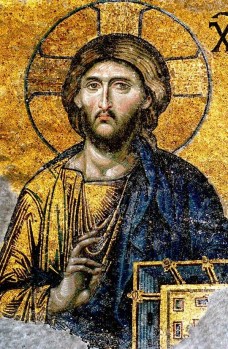
Appearances of the risen Jesus in Matthew’s gospel

In my previous post I explained why the gospel of Mark does not depict any appearances of the risen Jesus. In this post I move on to Matthew’s account of the resurrection appearances.

The gospel of Matthew presents two brief accounts of appearances of the risen Jesus. Both can be directly tied to particular interests of the author, indicating that they are his creation, although it is possible he knew something about Mark’s ending and adapted it to fit his own purposes. The possibility is more likely for his account of the second appearance, in which Jesus appears to his disciples in Galilee as the angels in both Mark and Matthew say he will.

In the first appearance, described in just a few verses, Jesus appears to the women on their way from the empty tomb to convey the angel’s message to the other disciples. (Mt 28:7-10) As I argued earlier on my page about the empty tomb, Matthew’s main purpose in creating the women’s encounter with Jesus is to slip in an appearance near the site of the tomb to establish that his body was resurrected and not stolen by the disciples, an accusation explicitly expressed in his gospel. He may have known that there were reports of multiple appearances of Jesus, as Paul recounts in his letter to the Corinthians (“he appeared to more than five hundred”), and so did not think an appearance to two women followers would be out of bounds for his story.

After he describes the chief priests bribing the guards to lie that Jesus’ disciples had stolen his body, Matthew abruptly jumps to Galilee with “the eleven disciples”—presumably the twelve apostles appointed by Jesus earlier in the gospel minus his betrayer Judas. This is the second, and final, appearance of the risen Jesus in Matthew’s gospel:

Now the eleven disciples went to Galilee, to the mountain to which Jesus had directed them. When they saw him, they worshiped him, but they doubted. And Jesus came and said to them, “All authority in heaven and on earth has been given to me. Go therefore and make disciples of all nations, baptizing them in the name of the Father and of the Son and of the Holy Spirit and teaching them to obey everything that I have commanded you. And remember, I am with you always, to the end of the age.” (Mt 28:16-20)

Jesus appears at a mountain, a traditional site of divine self-revelations such as to Moses on Mount Sinai; a favorite Matthean theme is that Jesus offers a new covenant for all people that goes beyond the covenant God established with the Israelites through Moses. Jesus’ instruction to his disciples to teach what he commanded echoes Moses delivering God’s commandments to the Israelites. (Deuteronomy 31:11-12; see also Mt 5:1, 21-48, from Jesus’ “Sermon on the Mount.”) The disciples worship Jesus, as the women had, emphasizing Matthew’s belief that Jesus had been exalted to a divine status, which is why Jesus can claim “All authority in heaven and on earth has been given to me.” The part of the verse in which witnesses doubt what they see is grammatically unclear and probably best interpreted as “some worshiped him, but some doubted,” perhaps a commentary on the responses of Matthew’s contemporaries the proclamation of Jesus’ resurrection. It has also been suggested that it expresses wavering belief, as when Peter tries to walk on water and begins to sink (Mt 14:29-31). (Licona, 2010: 360-361) Matthew is the only author in the Christian scriptural canon to use the Greek word “distazo” for doubt, which he uses in both passages. (Catchpole, 2000: 42)

The risen Jesus commissions the eleven to “make disciples of all nations” (literally “all peoples”). Another Matthean theme is his endorsement of the Christian mission to the gentiles. This activity was controversial among Christians at the time of Paul decades earlier, but by Matthew’s time he is comfortable indicating Jesus’ approval for the mission by reworking several passages from Mark’s gospel. (Catchpole, 2000: 43-52) Jesus’ command to baptize “in the name of the Father and of the Son and of the Holy Spirit” uses a Trinitarian formula that suggests theological development in the understanding of the relationship between God the Father, Jesus, and the Holy Spirit, and thus may be an early alteration of Matthew’s gospel by a copyist. Note though that the relation and relative status of the three is not spelled out in any explicit sense; rather the three are all brought together in endorsing baptism into the community of faith. Jesus then promises to be with his disciples “always,” until “the end of the age,” which ties back to a prophecy at the beginning of his gospel referring to Jesus as Emmanuel, or “God is with us.” (Mt 1:22-23) Matthew’s gospel ends at this point. He does not mention Jesus giving the disciples the power to forgive sins, as Jesus does in Luke and John (Lk 24:45-48; Jn 20:22-23), although Jesus himself is shown exercising this power during his life. (Matt 9:2-8) I wouldn’t make much of this difference, as Matthew probably understands the power to forgive sins as implicitly given to the disciples in Jesus’ commission.

Unlike the early appearance tradition recounted by Paul, Matthew does not mention an initial appearance of the risen Jesus to Peter. Instead he appears to those who came next in Paul’s chronology, “the Twelve” (minus Judas). I doubt Matthew knew much about the details of the appearances of Jesus reported by Paul. Instead he composed a brief collective experience focusing on Jesus’ commission to the apostles to announce God’s new covenant to “all peoples,” as the focus of the Christian mission had shifted decisively outside of Judea due to the war with Rome in 66-73 C.E.

References

Catchpole, David. (2000). Resurrection People: Studies in the Resurrection Narratives of the Gospels. Darton, Longman, & Todd.

Licona, Michael R. (2010). The Resurrection of Jesus. InterVarsity Press.

Paul on the risen Christ, part 3: Paul’s vision in context

The third part of my study of what Paul says about the resurrection is a new one. It’s based on passages that give more context to Paul’s experience of the risen Christ and his commission to preach “good news” to the gentiles. I’ve also included my conclusions from all three parts of my study of Paul’s letters.

Paul’s spiritual experiences

There are additional passages in the letters of Paul that shed a bit more light on Paul and the appearance of the risen Christ he experienced. (I will discuss the pivotal appearance to Peter on another page.) In his letter to the Christian community in Galatia Paul connected his vision of the risen Christ with his commission to preach to the gentiles. The letter starts off:

Paul an apostle—sent neither by human commission nor from human authorities, but through Jesus Christ and God the Father, who raised him from the dead… (Gal 1:1)

He then expands upon this further:

For I want you to know, brothers and sisters, that the gospel that was proclaimed by me is not of human origin; for I did not receive it from a human source, nor was I taught it, but I received it through a revelation of Jesus Christ. You have heard, no doubt, of my earlier life in Judaism. I was violently persecuting the church of God and was trying to destroy it. I advanced in Judaism beyond many among my people of the same age, for I was far more zealous for the traditions of my ancestors. But when the one who had set me apart before I was born and called me through his grace was pleased to reveal his Son to me, so that I might proclaim him among the gentiles, I did not confer with any human, nor did I go up to Jerusalem to those who were already apostles before me, but I went away at once into Arabia, and afterward I returned to Damascus. (Gal 1:11-17)

In writing that he was set apart before birth, Paul alludes to words of the prophets Isaiah (“the Lord…who formed me in the womb to be his servant”) and Jeremiah (“before you were born I consecrated you; I appointed you a prophet to the nations”) in the Jewish scriptures. Like the prophets he claims a divine mandate for his mission, asserting that his commission as an apostle came directly from Jesus and God and not through the original apostles in Jerusalem. According to Paul his commission and the message he preached stemmed from a revelation of Jesus to (or “in”) him, presumably referencing the appearance of the risen Jesus he lists in his letter to the Corinthians. Either the risen Jesus commissioned Paul and delivered the message he was to preach during his appearance to Paul, or Paul in his subsequent reflections on the appearance interpreted it as a commission to preach “the gospel” he proclaimed to the gentiles (gospel is Greek for “good news).

As a former persecutor of the early church, he would already have known their basic message that Jesus was the Messiah (Christ) and that he had been raised from the dead. Indeed, it is likely this message was a source of Paul’s opposition to the movement. Thus that would not have been the “gospel” he says he did not receive from a human source. In my judgment I don’t think it is warranted to assume Paul is saying Jesus announced to him that he, Jesus, was the Christ and had risen from the dead. Rather, the “good news” Paul was given to proclaim was the same one that gave him his mission: that the gentiles were being welcomed into the salvation offered by Christ. The appearance of the risen Christ caused Paul to accept what the Christians had already been preaching, but the gospel he was given had to do with Jewish scriptures that pointed to the gentiles turning to God in the end times.

Paul goes on to write that three years later he met Cephas and James in Jerusalem for the first time, and:

Then after fourteen years I went up again to Jerusalem with Barnabas, taking Titus along with me. I went up in response to a revelation. (Gal 2:1-2)

Note that it was seventeen years after his commissioning that he returned to Jerusalem. (His first visit was three years after the commissioning and his second visit another fourteen years later.) He returned there, he writes, “in response to a revelation.” He gives no indication as to whether this revelation came from another appearance of Jesus, from an auditory but not visual manifestation, via some kind of inner impulse he regarded as God-inspired, through a prophetic message from another Christian, or in some other fashion. It would not seem to have been another visual appearance, as in his letter to the Corinthians he characterized that appearance of the risen Jesus to him as the last appearance in a series: “Last of all… he appeared also to me.” However one interprets this later revelation, it shows that his communications from Jesus continued beyond his initial experience.

In his Second Letter to the Corinthians Paul reveals another type of spiritual experience:

I know a person in Christ who fourteen years ago was caught up to the third heaven—whether in the body or out of the body I do not know; God knows. And I know that such a person—whether in the body or out of the body I do not know; God knows—was caught up into paradise and heard things that are not to be told, that no mortal is permitted to repeat. (2 Cor 12:2-4)

Commentators agree that Paul is writing indirectly about himself in this passage. (Segal, 2004: 408) It is not clear whether his journey to the “third heaven” and the one to “paradise” were the same experience or two different ones. The “fourteen years ago” would place this some time after Paul’s initial experience of the risen Jesus but before the revelation that sent him to Jerusalem for the second time. The passage confirms that he had a series of spiritual experiences, not just one, and thus suggests that he may have cultivated a receptivity to such experiences through some type of mystical practices, such as those of the later Jewish rabbis, the heirs of the Pharisaic tradition. (Segal, 2004: 409-410) I will have more to say about this below.

After a few intervening lines Paul continues:

Therefore, to keep me from being too elated, a thorn was given me in the flesh, a messenger of Satan to torment me, to keep me from being too elated. Three times I appealed to the Lord about this, that it would leave me, but he said to me, “My grace is sufficient for you, for power is made perfect in weakness.” (2 Cor 12:7-9)

It is unclear whether the message about grace being sufficient was a part of the ecstatic experience(s) or Paul is connecting two different events. But again this passage confirms that Paul believed he continued to receive messages from Jesus long after his initial experience of the risen Christ.

As mentioned above, Paul’s reference to his heavenly journey(s) suggests that he may have engaged in deliberate practices that would make him receptive to spiritual experiences such as visions. The Greek word he uses for “revelation” in Galatians is apokalypsis, the same word used to identify a genre of ancient Jewish literature in which human beings ascend to heavenly places and return to reveal what they learned there. This literature includes the Biblical books of the Jewish prophets Ezekiel and Daniel and the Christian book of Revelation, as well as a host of other writings less well known today. (Segal, 2004: 405-416) Commentators often treat the kinds of unusual experiences recounted in these writings as a literary device to convey a message to select readers in coded language, but Paul’s heavenly journeys challenge this assumption. It may be that the authors, or at least some of them, actually engaged in methods meant to induce altered states of consciousness. These methods could include ascetic practices, intense concentration in prayer, the repetitive singing of hymns, and even psychotropic drugs. A resulting experience would then be interpreted through the influence of familiar religious texts, using similar symbologies and sometimes innovating with the introduction of new concepts, interpretations, or messages from God. (Segal, 2004: Ch. 8; Pilch, 2011: Chs. 2-4)

These additional passages in letters of Paul put his experience of the risen Christ into a larger perspective. As would be expected of a Pharisee zealous for his Jewish traditions, Paul was well-versed in the scriptures and skilled in arguing from them. As an enemy of the Christians he would have paid close attention to the scriptural references they used to prove that Jesus was the Messiah in order to refute them. He surely knew the scriptural passages about the gentiles turning to the true God in the end times. These issues would have preoccupied him, and he likely prayed for God’s guidance in wrestling with the Christian arguments. Psychologically he was prepared to receive an answer. He probably engaged in practices meant to increase his receptivity to visions and messages from God, as the appearance of Jesus was only one of several spiritual experiences he had, and possibly not the first one. But this one had two distinguishing features. First, he experienced an appearance of the Jesus the Christians said had been raised from the dead, a figure who had certainly been on his mind. And second, he believed this appearance had commissioned him to preach to the gentiles that they were being welcomed into the kingdom of God.

Conclusions

In his First Letter to the Corinthians, Paul transmitted a carefully preserved Christian tradition indicating that Peter was the first to claim to have seen the risen Christ, followed by an appearance to “the twelve.” The prominence of Peter in the early Christian community aligns with this tradition. Paul was aware of several other reports of appearances but these are not attested in any other source. He also experienced an appearance himself. The nature of a resurrected body was a controversial issue among the Corinthian Christians. In trying to explain what a resurrected body is like, Paul rejected the common idea that it would be our familiar flesh and blood body restored to life while at the same time maintaining the Pharisaic and Christian belief that there is continuity between the body that dies and the body that rises in its glorified form. Paul had other spiritual experiences, including continued messages he believed came from Jesus. He may have engaged in practices meant to make him receptive to visions and messages from God. As a persecutor of the Christian community he would have been asking God for guidance in using the Jewish scriptures to refute the Christians; this preoccupation was the context in which he experienced an appearance of the risen Christ. This appearance convinced him that he had been commissioned him to preach to the gentiles that the way to salvation had opened to them, mirroring passages in the scriptures that seemed to predict this happening in the end times.

Sources cited

Pilch, John J. (2011). Flights of the Soul: Visions, Heavenly Journeys, and Peak Experiences in the Biblical World. William B. Eerdmans Publishing Company.

Segal, Alan F. (2004). Life After Death: A History of the Afterlife in the Religions of the West. Doubleday.